
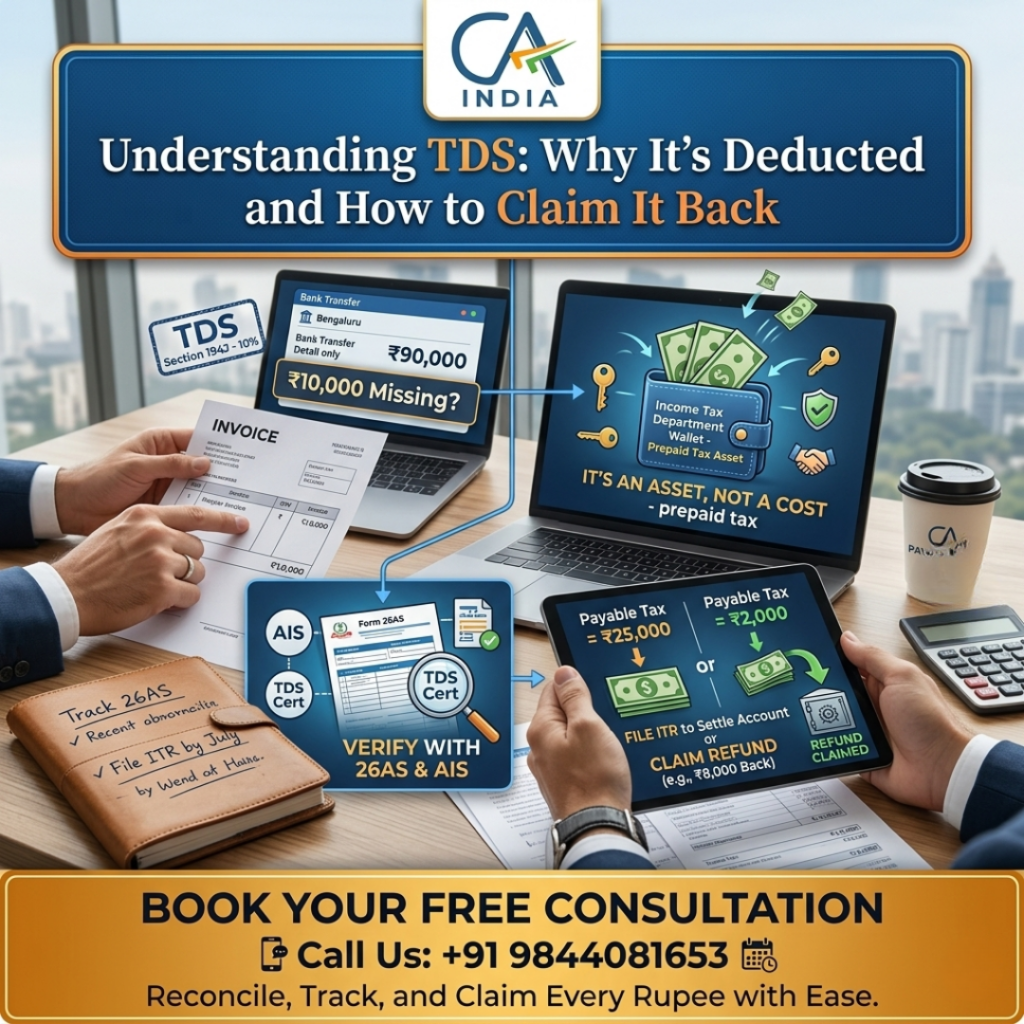
You just closed a great deal. You provided consulting services to a corporate client, and at the end of the month, you excitedly sent them an invoice for ₹1,00,000.
A week later, you check your bank account. The client has paid you, but the amount transferred is only ₹90,000.
Did they shortchange you? Are they holding back 10% for poor performance?
You call their finance team, and they casually reply, “Oh, we deducted 10% TDS under Section 194J.“
At CA Pavan Kumar & Co., we regularly meet new business owners and freelancers who are frustrated by this. They feel like their hard-earned money is being randomly confiscated. But here is the secret: that ₹10,000 is not gone. It still belongs to you.
Here is exactly what Tax Deducted at Source (TDS) is, why it happens, and most importantly, how to get your money back.
1. Why Does the Government Do This? (The Logic of TDS)
The Income Tax Department doesn’t want to wait until the end of the financial year (March 31st) to collect taxes. They want a steady stream of revenue all year round. They also want to prevent tax evasion.
So, they created the TDS system. The government forces the person paying you (your client) to act as a tax collection agent.
Before your client pays your invoice, the law requires them to deduct a specific percentage (like 1% for contracts, 2% for technical services, or 10% for professional fees), deposit that slice directly to the government, and give the rest to you.
2. It Is Not a Cost; It Is an Asset
The biggest mistake business owners make is recording the ₹10,000 deduction as an “expense” or a “loss” in their accounting software.
It is not an expense. It is Prepaid Tax. Think of it like a digital wallet held by the Income Tax Department in your name. Every time a client deducts TDS, they are depositing money into your government wallet. You have essentially paid your income tax in advance.
3. Trust, But Verify (The Danger of Unpaid TDS)
This is where things can go wrong. What if your client deducts the ₹10,000 from your invoice but forgets to deposit it with the government?
If they don’t deposit it, the government doesn’t know it belongs to you, and you will lose that money. You must verify that your clients are actually doing their job.
- Form 26AS & AIS: Log into your Income Tax Portal and check your Form 26AS and Annual Information Statement (AIS). These documents act like a passbook. They show every single rupee of TDS that has been deposited against your PAN card.
- TDS Certificates (Form 16A): Every quarter, ask your clients to send you a Form 16A. This is the official legal proof that they have deducted and deposited the tax on your behalf.
4. How to Claim Your Money Back (The Refund)
So, you have ₹10,000 sitting in your TDS wallet. How do you get it back into your bank account?
The only way to settle the account is by filing your Income Tax Return (ITR) at the end of the year.
- Scenario A: You owe more tax. Let’s say your business made a massive profit, and your total calculated tax liability for the year is ₹25,000. You don’t have to pay ₹25,000 out of pocket. You tell the government, “Keep the ₹10,000 you already have in my TDS wallet, and I will just pay the remaining ₹15,000.”
- Scenario B: You get a refund. Let’s say your business had a lot of expenses, and your actual tax liability for the year is only ₹2,000. But the government has ₹10,000 of your TDS. When we file your ITR, we claim the difference. The Income Tax Department will directly transfer the remaining ₹8,000 refund to your bank account!
Stop Leaving Money on the Table
Every year, crores of rupees go unclaimed simply because business owners don’t track their TDS or file their returns properly. Don’t let your hard-earned profit sit in a government account indefinitely.
Let us reconcile your books, track your Form 26AS, and ensure every single rupee of your TDS is either adjusted or refunded.
Schedule your appointment now by visiting our website: https://capavankumar.com/
- 📞 Call us: +91 9844081653
- 📧 Email: capavankumars@gmail.com