
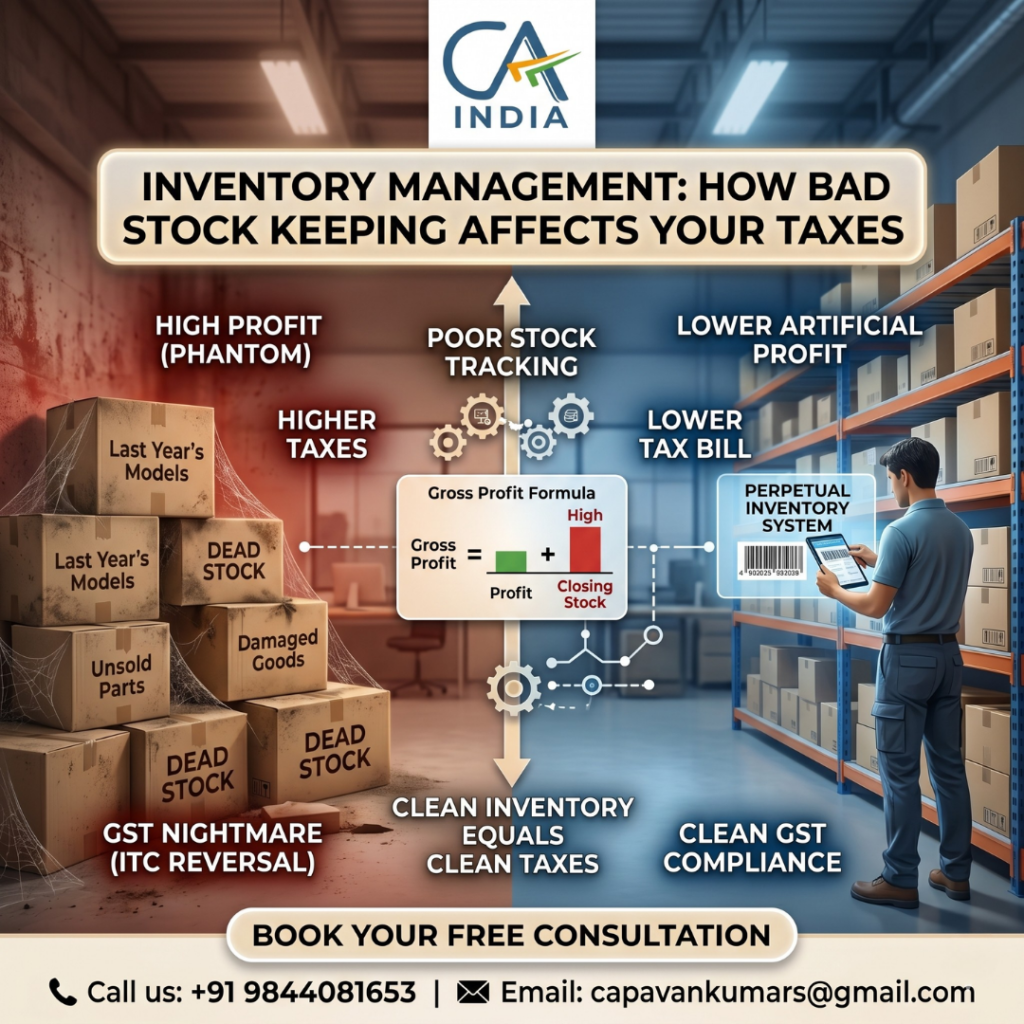
Walk into the backroom or warehouse of almost any growing retail or manufacturing business, and you will see it: the “dead corner.”
It is that pile of dusty boxes filled with last year’s unsold models, slightly damaged goods, or spare parts for products you no longer make.
To a business owner, that pile of unsold stock is just an annoyance taking up physical space. But at CA Pavan Kumar & Co., we look at that same pile and see a massive financial leak.
Bad inventory management doesn’t just hurt your cash flow; it also affects your tax liability. If you aren’t tracking your stock accurately, there is a very high chance you are paying the government taxes on profits you never actually made.
Here is how poor stock-keeping inflates your tax bill, and how to fix it before your next audit.
1. The Profit Formula: How Unsold Stock Increases Tax
To understand why inventory matters for taxes, you have to understand how Gross Profit is calculated in your Trading Account:
Gross Profit = Sales + Closing Stock – (Opening Stock + Purchases)
Notice the position of “Closing Stock” in that formula. It is added to your sales. This means that the higher your closing stock value is at the end of the year, the higher your Gross Profit will be. And the higher your Gross Profit, the more Income Tax you have to pay.
2. The “Dead Stock” Trap (Paying Tax on Phantom Profits)
Let’s go back to those dusty boxes in the corner of your warehouse. Suppose you bought those items two years ago for ₹5 Lakhs. Your accounting software probably still lists their value as ₹5 Lakhs.
Because they are sitting in your “Closing Stock” at their original cost, they are artificially inflating your profit by ₹5 Lakhs. You are paying 25% to 30% tax on that phantom profit!
- The Fix (The Rule of NRV): Accounting standards strictly state that inventory must be valued at “Cost Price or Net Realizable Value (NRV), whichever is lower.” If that dead stock can only be sold to a scrap dealer today for ₹50,000, you must write down its value in your books immediately. This reduces your artificial profit and instantly lowers your tax bill.
3. The GST Nightmare: Missing Stock and ITC Reversal
Inventory issues don’t just affect Income Tax; they trigger massive GST problems. When you buy raw materials or trading goods, you claim Input Tax Credit (ITC) on them. You are legally telling the government, “I am going to sell these goods and collect tax later.”
- The Danger: What happens if goods are stolen, destroyed in a flood, completely damaged, or given away as free promotional samples?
- The Rule (Section 17(5) of the GST Act): You cannot keep the ITC. The law mandates that if inventory is lost, destroyed, or given away, you must reverse the ITC you claimed on it.
- The Consequence: If you have poor physical stock tracking and wait until a GST audit to discover that ₹10 Lakhs worth of inventory is “missing,” the GST officer will force you to reverse the ITC and pay a heavy penalty along with 18% interest.
4. The “Unexplained Investment” Notice
The Income Tax Department knows that inventory is the easiest place for businesses to manipulate their profits. That is why it is the first thing they check during a scrutiny assessment or a tax raid.
- The Scenario: The tax officer walks into your warehouse and does a physical count. Your accounting books say you should have ₹50 Lakhs of stock, but the physical count reveals ₹70 Lakhs of stock.
- The Result: The officer will classify that extra ₹20 Lakhs as an “Unexplained Investment” under Section 69 of the Income Tax Act. You will be slapped with a brutal tax rate of over 78% on that discrepancy, wiping out your working capital overnight.
5. Move from “Yearly Counting” to “Perpetual Inventory”
The root cause of all these tax problems is treating inventory management as a one-time event on March 31st.
You need to shift to a Perpetual Inventory System using strong barcode or RFID-integrated software. Every time an item is sold, scrapped, or returned, your books should update instantly.
Clean Inventory Equals Clean Taxes
Your warehouse and your balance sheet are deeply connected. Stop letting obsolete stock sit on your books and inflate your tax liabilities.
Let us review your inventory valuation methods. We will help you legally write off dead stock, reconcile your GST credits, and ensure you only pay tax on the real profit you take home.
Schedule your appointment now by visiting our website: https://capavankumar.com/
- 📞 Call us: +91 9844081653
- 📧 Email: capavankumars@gmail.com