
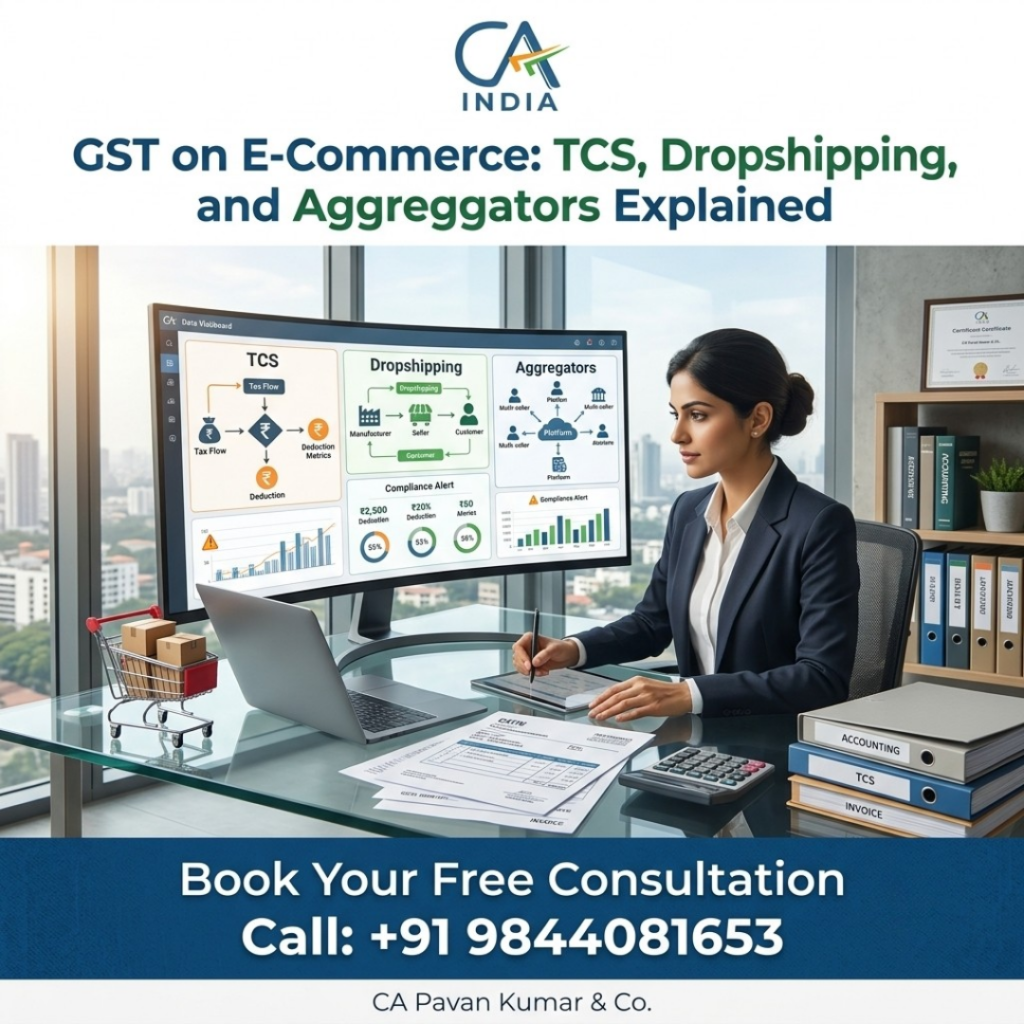
You have a great product idea. You set up a seller account on Amazon, Flipkart, or your own Shopify store, and you are ready to launch your direct-to-consumer (D2C) brand.
Because you are just starting, you assume you don’t need to worry about Goods and Services Tax (GST) yet. After all, everyone knows that businesses only need a GST registration if their annual turnover crosses ₹40 Lakhs, right?
Wrong.
When it comes to e-commerce, the Income Tax and GST departments throw the standard rulebook out the window. Selling goods online triggers a completely different set of compliance laws.
At CA Pavan Kumar & Co., we specialize in helping digital-first brands navigate these complex rules. If you sell online, use a dropshipping model, or run a service via an aggregator app, here is the reality of your GST obligations.
1. The “Zero Exemption” Rule for Online Sellers
Under Section 24(ix) of the CGST Act, the ₹40 Lakh turnover exemption does not apply to e-commerce sellers.
- The Law: If you supply goods through an e-commerce operator (like Amazon, Myntra, or Meesho), obtaining a GST registration is mandatory from day one, regardless of your turnover.
- The Reality: Even if you only sell one t-shirt for ₹500 in your first month, you must have an active GSTIN. E-commerce platforms are legally prohibited from allowing you to list products on their sites without it.
- D2C Sites: If you sell exclusively through your own website (not an aggregator), you still trigger mandatory registration the moment you ship a product across state lines (interstate supply).
2. The 0.5% TCS Trap (Tax Collected at Source)
Why did the government mandate GST for every online seller? Because they use the e-commerce platforms to track you. Under Section 52 of the GST Act, e-commerce operators are required to act as tax collectors.
- How it Works: Every time you make a sale, the platform (e.g., Amazon) deducts a 0.5% TCS (Tax Collected at Source) from your payout. (This rate was recently reduced from 1% to ease working capital blockages). They deposit this money directly into the government’s account under your GSTIN.
- The Trap: This 0.5% is not a cost—it is your money. It sits in your Electronic Cash Ledger on the GST portal. However, you only get credit for it if you actively accept the TCS in your monthly filings. Many unguided sellers ignore this step, leaving thousands of rupees of their own working capital locked in the government portal.
3. Dropshipping: The “Place of Supply” Puzzle
Dropshipping is highly popular because you don’t hold inventory. When a customer orders from your website, you purchase the item from a third-party manufacturer, who ships it directly to the Customer.
From a GST perspective, this is a complex “Bill To / Ship To” transaction involving three parties in potentially three different states.
- Leg 1 (Manufacturer to You): The manufacturer bills you. They will charge IGST or CGST/SGST, depending on whether your registered state matches theirs. You claim this as Input Tax Credit (ITC).
- Leg 2 (You to the Customer): You bill the end customer. You must charge GST based on the Customer’s delivery state, not the manufacturer’s state.
- The Danger: If you misclassify the “Place of Supply,” you will pay the wrong type of tax (e.g., paying state tax instead of integrated tax). The GST department will later force you to pay the correct tax again, without immediately refunding the wrong tax you initially paid.
4. Section 9(5): When the Platform Pays the Tax
There is a massive exception to the rules above. If you provide certain services through an aggregator app, the government shifts the GST liability entirely away from you and onto the platform itself.
Under Section 9(5) of the CGST Act, this applies to:
- Food Delivery: Restaurants selling via Swiggy or Zomato.
- Passenger Transport: Drivers on Uber or Ola.
- Accommodation: Small hotels or homestays listed on MakeMyTrip or Airbnb.
- Housekeeping Services: Plumbers or cleaners on Urban Company.
If you fall into these categories, the platform charges and pays the 5% or 18% GST on your behalf. However, you must still maintain strict accounting records to separate your online platform sales from your direct walk-in sales.
Automate Your E-Commerce Compliance
Running an e-commerce brand means dealing with high-volume, low-ticket transactions, massive return rates, and automated platform commissions. You cannot manage this with manual spreadsheet accounting.
Let our tech-driven accounting team integrate your Shopify, Amazon, and payment gateway data directly into our GST systems. We will reconcile your TCS, claim your Input Tax Credits, and keep your cash flow optimized.
Schedule your appointment now by visiting our website: https://capavankumar.com/
- 📞 Call us: +91 9844081653
- 📧 Email: capavankumars@gmail.com