
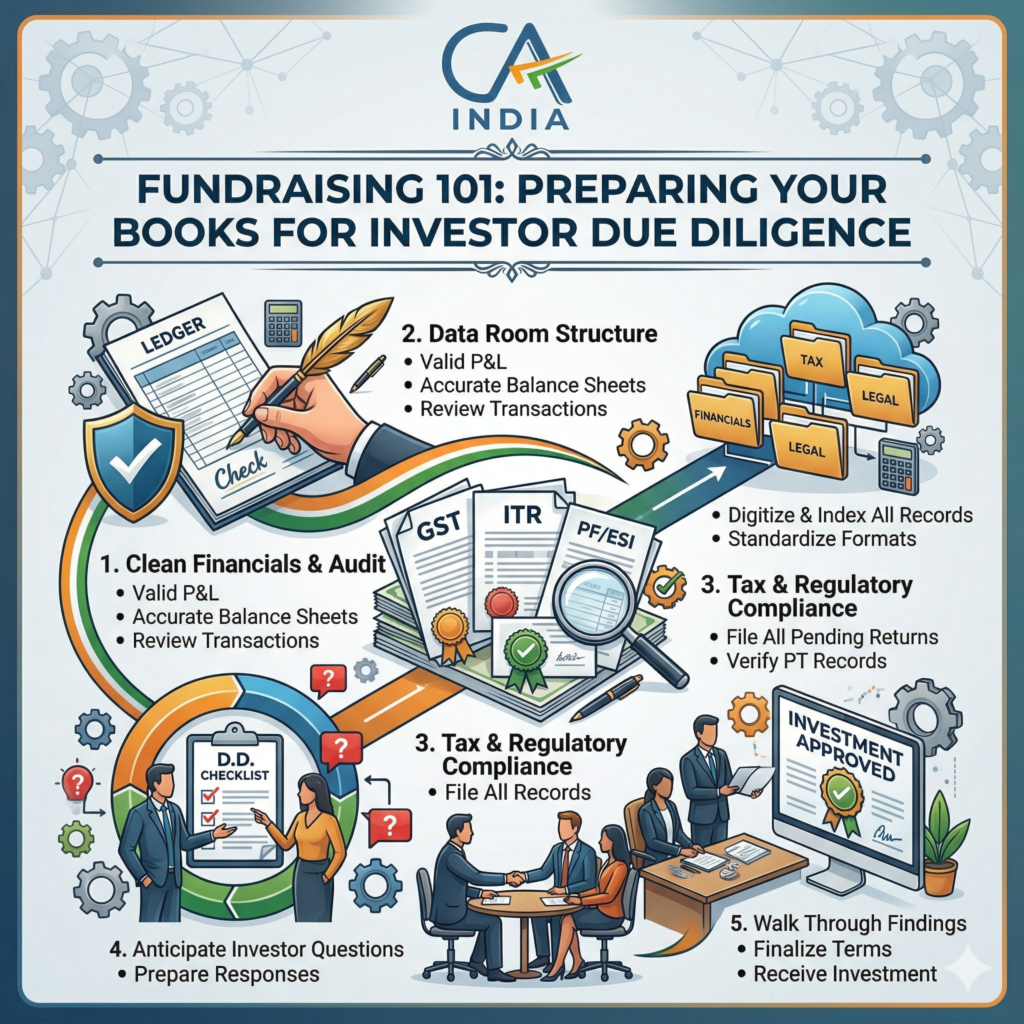
You nailed the pitch. The Venture Capital (VC) partners loved your vision, and they have offered you a Term Sheet for ₹5 Crores.
You are ready to pop the champagne. But then the VC says,
“Great, our legal and finance teams will start the Due Diligence tomorrow.” Suddenly, the excitement turns into panic.
At CA Pavan Kumar & Co., we have sat on both sides of the Due Diligence (DD) table. We know exactly what investors are looking for. They want to ensure that the beautiful growth numbers you showed in your presentation match the actual bank statements. If your books are a mess, investors will either lower your company’s valuation or walk away from the deal entirely.
If you are planning to raise funds in the next 12 months, here is how to prepare your books so you can pass Due Diligence with flying colors.
1. Stop Commingling Personal and Business Funds
This is the #1 red flag for any investor. When you are bootstrapping, it is common to accidentally pay for a business server using your personal credit card or pay for a personal grocery run using the company UPI.
- The VC Perspective: If an investor sees personal Swiggy bills mixed with business expenses, they assume you lack financial discipline. Worse, it makes it impossible to calculate your true “burn rate.”
- The Fix: Draw a hard line today. Ensure 100% of business income and expenses flow only through the corporate current account. If you paid out of pocket, file a formal expense reimbursement voucher.
2. Clean Up Your Cap Table
Your Capitalization Table (Cap Table) is a spreadsheet showing exactly who owns how much of your company.
- The VC Perspective: Investors want a clean cap table. If you promised 2% equity to an early advisor, 5% to an ex-employee who left on bad terms, and 10% to your uncle who loaned you money, your equity is “cluttered.”
- The Fix: Ensure every single share issued is backed by a formal board resolution and proper MCA filings. Clear any handshake agreements and convert informal family loans into formal debt agreements before the VC looks at them.
3. Settle Your Statutory Dues (No “Tax Debt”)
Investors are giving you money to grow your product, not to pay off your old tax penalties. During DD, the audit team will check if you are up to date on your TDS, GST, Professional Tax, and Provident Fund payments.
- The VC Perspective: Unpaid taxes are a massive legal liability. If you haven’t been paying your TDS, the government can freeze the company bank account—locking up the investor’s money.
- The Fix: Pay off any pending tax challans immediately. Run a reconciliation to ensure your GSTR-3B matches your GSTR-1 and 2B perfectly.
4. Proper Expense Categorization
When you enter an expense into your accounting software, categorization matters.
- The Scenario: You bought ₹5 Lakhs worth of laptops for your new engineering team.
- The Mistake: If your accountant records this under “Office Expenses” instead of “Fixed Assets,” your Profit & Loss statement will show a massive, artificial loss for that month.
- The Fix: Conduct a pre-audit review of your ledgers. Ensure assets are capitalized and depreciated correctly, and that one-time expenses are separated from recurring operational costs.
5. Have Your Contracts Ready
Due Diligence isn’t just about numbers; it’s about the legal paper trail behind those numbers.
If your books show ₹50 Lakhs in revenue from your top client, the VC will ask to see the Master Service Agreement (MSA) signed by that client. If you are paying rent, they will want to see the registered lease agreement. Organize a “Data Room” (a secure Google Drive or Dropbox folder) with every vendor contract, employee offer letter, and client agreement neatly categorized.
Run a “Mock” Audit Before the Real One
Don’t wait for the VC’s auditors to find your mistakes. The best strategy is to find them yourself first.
A “Pre-Funding Health Check” acts as a mock Due Diligence. We review your books through the harsh lens of an investor, fix the leaks, and ensure your financial data is bulletproof.
Don’t let messy accounting kill your term sheet.
Schedule your appointment now by visiting our website: https://capavankumar.com/
- 📞 Call us: +91 9844081653
- 📧 Email: capavankumars@gmail.com