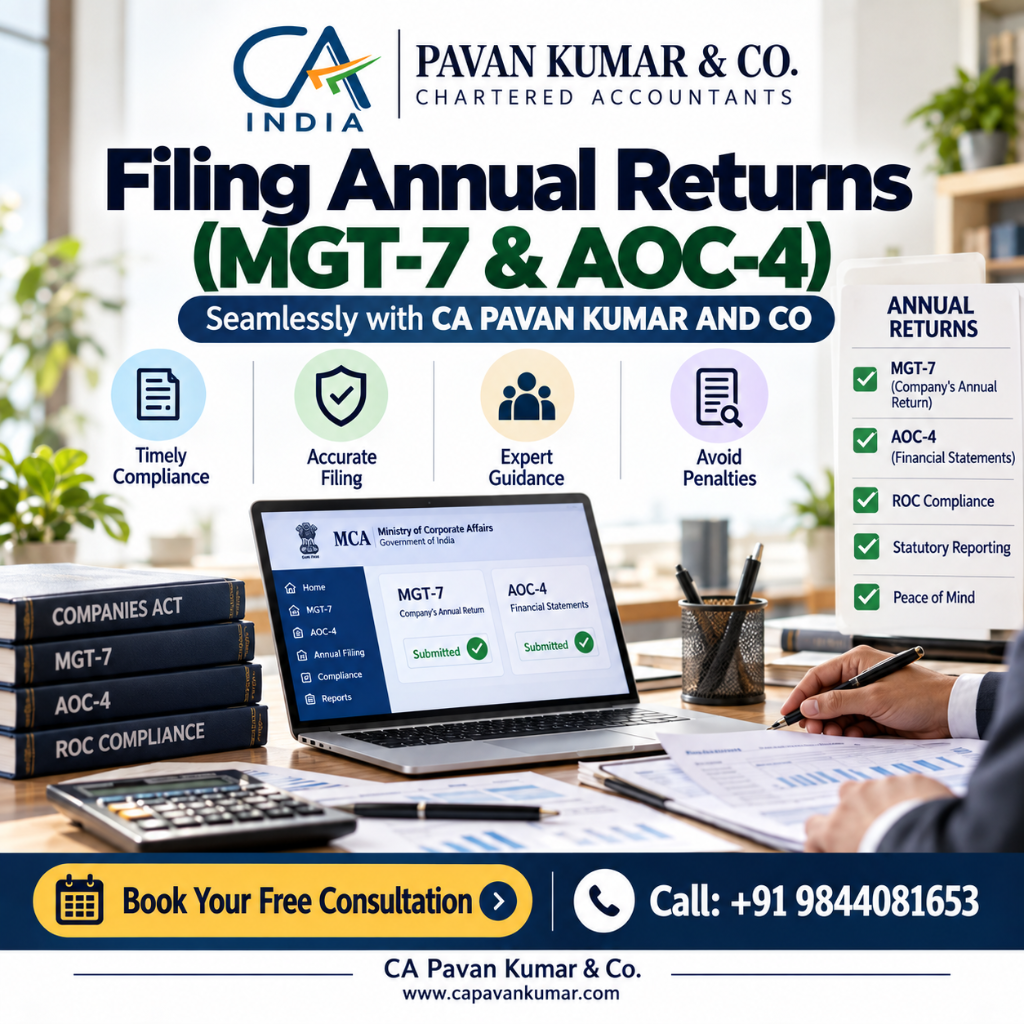
Annual compliance is a mandatory requirement for all companies operating in India. There are filings, even if a company has limited operations during a financial year.
ROC annual compliance requirements include submission of particulars and documents to the Registrar of Companies (ROC). There are two important forms pertaining to annual compliance, namely AOC-4 and MGT-7. MCA describes AOC-4 as the financial statements and other documents filing and MGT-7 as the company’s annual return.
This, however, is subject to the nature of the company. MCA Rules provide for MGT-7A for One Person Companies (OPCs) and small companies from Financial Year 2020-21 onwards, as opposed to MGT-7.
This is especially important for start-ups, established businesses and companies based in Bangalore, as timely MCA compliance ensures up to date and accurate corporate records.
What are MGT-7 and AOC-4?
AOC-4: Financial Statements
As per the MCA, AOC-4 is a form for the filing of financial statements and other documents with the ROC.
The filing package will depend on the company and applicable requirements. It may include financial statements and other supporting documents like the Board’s report, auditor-related information and other prescribed attachments.
MGT-7: Annual Return
MGT-7 is the annual return filed by certain companies.
An annual return is a statutory form through which a company is required to provide information about its registered office; the nature of its principal business activities; and its shareholding and management, as the case may be.
It should be noted that AOC-4 and MGT-7 serve different functions and should not be confused with each other. AOC-4 is more related to financial statements and associated documents and MGT-7 is more related to the company’s annual return. They are part of the broader annual ROC compliance.
Why is Annual ROC Compliance Necessary?
Private Limited Companies
Private limited companies continue to have ongoing statutory obligations and associated annual filings post-incorporation.
Public Limited Companies
Public companies have a heightened need for compliance and governance, therefore, compliance management is a must for such companies.
Start-ups
During the initial years, start-ups may be focused on rapid growth, product development and capital raising. However, they continue to have ongoing statutory and ROC obligations.
Growing Businesses
As a company continues to expand its business, its compliance obligations also increase. For example, increases in directorship, shareholding and changes in the company’s registered office and business activities also impact the complexity of annual compliance.
The information furnished to the MCA must be in line with the company’s books, financial statements, statutory records, and other relevant records.
There are several combinations of the records which, if not in sync, may lead to complications such as filing queries and the need for resubmissions. These combinations include:
-Financial statements and accounting records
-Shareholding records and statutory records
-Information about directors and MCA records
-Information about auditors and records of the company
-Information provided in the annual return and company documents
An MGT 7 AOC 4 filing process is a detailed one. Prior diligence is key to a smooth process.
Key Documents and Information Required
Depending on the nature and activities of a company, records required to be maintained by that company, the documents and information required to be submitted for compliance with the relevant provisions of the Companies Act, 2013 and the rules made there under may include:
-Audited financial statements
-Board’s report
-Auditor’s report
-Accounting records
-Names and details of directors and KMP
-Particulars of registered office
-Details of share capital
-Changes in the directors of the company during the year
-Minutes of meetings
-Loans and investments and related transactions
-Prevailing information submitted by the company to the Registrar
-Digital signature of directors / officers
-Applicable professional certification
The company’s books and statutory records must be reviewed prior to preparing the forms.
Step-by-Step ROC Annual Compliance Filing Process
Step 1: Review the Company’s Compliance Status
This includes inspecting the company’s records of incorporation, previous filings, records of directors, and the MCA master data.
Step 2: Finalize the Financial Statements
The financial statements must be finalized and audited (if required) prior to the relevant annual filing process.
Step 3: Reconciliation of Compliances
Information provided in the financial statements must be reviewed against the accounting records and statutory records of the company.
Step 4: Prepare AOC-4
The required financial information and supporting documents have been provided on the applicable AOC-4 form.
Step 5: Prepare the Annual Return
The annual return is prepared using the current information of the company, and the form applicable to the company is either MGT-7 or MGT-7A.
Step 6: Verify and Digitally Sign
Prior to being digitally signed by the authorized person and professional where certification is necessary, the forms and attachments are reviewed for completeness and accuracy.
Step 7: File Through the MCA System
The forms are filed on the MCA website with the applicable fees.
Step 8: Preserve the Filing Records
Acknowledgements and challans of the filed forms are retained as part of the company’s compliance records.
Important Deadlines
Annual filing deadlines are prescribed under the Companies Act, rules and applicable MCA requirements. They are not the same for all companies or all filings.
The deadlines may be based on when the company holds its annual general meeting, what type of company it is, and/or what statutory provisions apply.
The MCA’s official website should be consulted to verify which forms and filing processes are in effect. The MCA has also issued updates on the company filings process, and moved company filing forms to its V3 platform.
The Ministry of Corporate Affairs
Because deadlines, forms, attachments and filing requirements can change, businesses should verify the relevant requirements for the financial year in question, as opposed to relying on a past compliance calendar.
Common ROC Filing Mistakes to Avoid
Filing without reconciling company records
The information in MGT-7/ MGT-7A must be in line with the company’s statutory records.
Using the Wrong Form
Not all companies use the same annual return form. Example: As per the relevant rules, applicable OPCs and small companies use MGT-7A.
Ministry of Corporate Affairs
Ignoring Changes During the Year
Changes in Directors, share capital, Registered Office, etc. have to be reviewed for the annual filing.
Leaving Filing Until the Last Minute
Last minute filing can lead to major problems if documentation has to be corrected or certified by professionals, or in case the MCA system rejects the return and requires a resubmission.
Overlooking Attachments
An annual filing package has to be complete. An incomplete package can be rejected.
Treating ROC Compliance as a One-Time Task
Compliance is an ongoing responsibility. Other than annual return filing, there are other statutory compliances like company, income tax, GST and other compliances which also need to be reviewed and taken care of.
Benefits of Professional CA Support
Annual compliances are more organized and less stressful if a company has numerous compliances.
A C.A. compliances process can help a company review financial and corporate information, coordinate with the company’s accountant, and help prepare and file documentation for the annual return.
Additionally, a C.A. can also identify inconsistencies in the annual return filings.
Where the case requires company-secretarial functions or specific professional certification, a CA may coordinate with an appropriately qualified CA company secretary or other professional, as the case may be.
Why Choose Pavan Kumar & Co?
Pavan Kumar & Co is a Chartered Accountant firm based in Seshadripuram, Bengaluru, with a practice covering tax, GST, accounting, audits, business registration, advisory and corporate and LLP regulatory compliance.
Pavan Kumar & Co works with corporates, startups, LLPs, professionals and individuals and focuses on clarity and timely execution, with practical assistance for compliance.
In addition, the firm provides services such as business registration and compliance, accounting and bookkeeping, tax and GST compliance, internal and statutory audits and regulatory compliance for corporates and LLPs.
For companies needing support for ROC annual compliance filing in Bangalore, this integrated approach is useful, as annual corporate compliance often requires up-to-date corporate books, finalized accounts and financial statements.
Frequently Asked Questions
1. What is ROC annual compliance filing?
ROC annual compliance filing refers to the periodic submission of prescribed company information, financial statements and annual returns to the Registrar of Companies through the MCA system, as applicable to the company.
2. What is the difference between MGT-7 and AOC-4?
AOC-4 is primarily associated with filing financial statements and related documents with the Registrar. MGT-7 is an annual return form containing prescribed corporate information. They serve different compliance purposes.
3. Do small companies file MGT-7?
Not generally. Under the applicable rules, an OPC and small company file the annual return in MGT-7A from financial year 2020-21 onwards. The company’s current status and applicable rules should be verified for the relevant year.
4. Can a company with little business activity skip annual ROC filing?
A company should not assume that low or no business activity removes its statutory filing obligations. Applicability depends on the company’s status and the relevant provisions.
5. Can a CA help with MGT-7 and AOC-4 filing?
A CA can assist with accounting, financial statements, compliance review and applicable corporate filings within the scope of their professional services. Where a filing requires a particular certification or company-secretarial function, the appropriate qualified professional should be involved.
Ensure Timely ROC Filings with CA Pavan Kumar & Co
Annual corporate compliance is easier to manage when financial statements, statutory records and MCA filings are coordinated throughout the year.
Whether you are a startup, private company, growing enterprise or established business in Bangalore or elsewhere in India, professional support can help create a more organized approach to ROC annual compliance filing.
Requirements, deadlines, documents and applicable forms may vary based on the company type, financial year and current MCA regulations. Companies should therefore obtain professional advice based on their specific circumstances.
Get an appointment to speak with our expert team and discuss your accounting and compliance requirements.
Pavan Kumar & Co.
Sannidhi, 26, RK Street, Jai Bheema Nagar, Seshadripuram, Bengaluru, Karnataka – 560020
Call: +91 9844081653
Email: capavankumars@gmail.com
This blog is for educational purposes only and should not be treated as tax, legal, or financial advice. Please consult a qualified chartered accountant for advice based on your specific situation.