
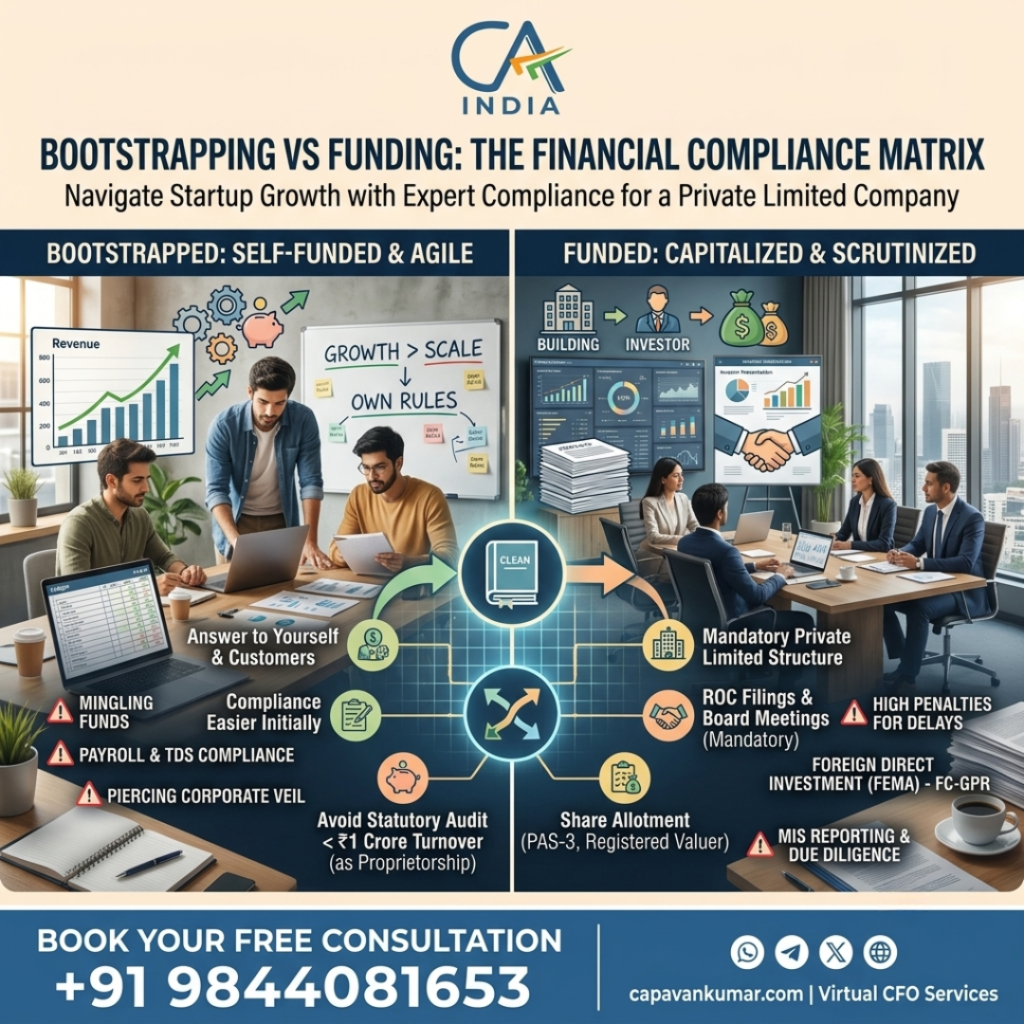
Founders reach a major crossroads during the early phases of scaling. Specifically, they must decide between two distinct paths. Should your startup bootstrap using personal savings and organic revenue? Alternatively, should you seek venture capital for aggressive scaling?
Most founders focus heavily on two factors. They weigh company dilution against the speed of market scaling. However, they often completely ignore a massive third factor. That critical factor is the Compliance Burden.
At CA Pavan Kumar & Co., we regularly witness two extreme scenarios. We see ambitious founders raise millions of rupees, only to get buried by immediate corporate compliance demands. Conversely, we see bootstrapped founders suffer severe penalties for ignoring basic accounting laws.
Below, we break down what it really means to run a bootstrapped versus a funded startup from a regulatory perspective.
1. Bootstrapped Reality: Lean, Fast, and Risky
Bootstrapping means you answer only to yourself and your customers. Consequently, your day-to-day compliance remains easier. However, your personal financial risk becomes much greater.
- Mingling Funds (The Worst Violation): Bootstrapped founders often use personal accounts to cover business expenses. For example, they might use personal credit cards for AWS servers or personal cash for office rent.
- The Compliance Risk: From the Income Tax Department’s perspective, this constitutes a serious violation. If you run a Private Limited Company or LLP, mingling funds “pierces the corporate veil.” Consequently, you become personally liable for company debts and attract harsh tax penalties.
- The ‘Sweat Equity’ Trap: Bootstrapped founders frequently skip formal salary distributions during lean months. Instead, they withdraw funds from the business account as they see fit.
- The Solution: Even if you are entirely self-funded, you must run a formal payroll. Furthermore, you must deduct TDS appropriately. Finally, you need to file personal income tax returns to maintain a clean, formal legal history.
- The Audit Advantage: If you bootstrap as a Sole Proprietorship, you generally avoid a statutory audit altogether. This exemption lasts until your annual turnover exceeds ₹1 Crore (or higher thresholds under presumptive taxation schemes).
2. The Funded Reality: High Capital, High Scrutiny
Once an Angel investor or VC wires funds to your business account, your compliance requirements increase 100-fold. You are no longer just building a product. Instead, you are managing institutional wealth.
- Mandatory Private Limited Structure: A Sole Proprietorship or Partnership cannot attract institutional investors. Therefore, you must incorporate as a Private Limited Company. This transition leads to mandatory annual ROC filings (AOC-4 and MGT-7), mandatory board meetings, and statutory audits. This applies regardless of your current turnover.
- The Valuation & Allotment Document: Share allotment involves strict corporate paperwork. You cannot simply issue shares informally after collecting funds. Instead, you must retain a Registered Valuer (for FEMA) or a Merchant Banker (for Income Tax). Furthermore, you must report share allotment to the Ministry of Corporate Affairs (MCA) via the PAS-3 form within 30 days. Non-compliance leads to aggressive, compounding penalties.
- Due Diligence & MIS Reporting: VCs view their investment as a strict business partnership. Consequently, your Term Sheet will likely include clauses for monthly MIS reporting. If your bookkeeping is disorganized or your accountant is slow, you may violate your investor agreement.
3. The FEMA Factor: Foreign Direct Investment
Raising funds from foreign investors—including international accelerators like Y Combinator or offshore NRIs—triggers strict FEMA regulations.
- The Bootstrapped Advantage: If you build your company solely with local revenue, you never have to worry about cross-border compliance or FEMA filings.
- The Funded Burden: When foreign money hits your bank account, you face a strict regulatory deadline. Specifically, you have 30 days from the date of share issuance to submit the FC-GPR (Foreign Currency Gross Provisional Return). You must submit this through your authorized dealer bank directly to the Reserve Bank of India (RBI). The RBI maintains a strict zero-tolerance policy for delays. Consequently, delayed filings require compounding applications that cost several lakhs in legal fees and take months to resolve.
4. The Exit Strategy: Clean Books Command Higher Valuations
Ultimately, your startup aims for a successful acquisition, a merger, or an IPO. Regardless of your funding path, you need consistent exit readiness.
When a larger corporation decides to acquire your startup, their team performs detailed Financial Due Diligence. If they find ongoing GST litigation, missing PF/ESI contributions for early employees, or unfiled ROC returns, they act decisively. They will either significantly decrease your valuation or walk away from the deal entirely.
Don’t Let Compliance Slow Your Growth
As a founder, your core responsibility is to develop your product, drive sales, and manage your employees. Consequently, you should not spend your weekends reading the Companies Act or filing complicated FC-GPRs.
Whether you are a bootstrapped team organizing your first financial ledgers or a funded startup preparing for a Series A due diligence audit, you need an experienced partner. Let our Virtual CFO and compliance team manage your corporate governance. Ultimately, this allows you to prioritize scaling your business safely.
Reach out to us today to schedule a consultation:
- Website: https://capavankumar.com/
- 📞 Phone: +91 9844081653
- 📧 Email: capavankumars@gmail.com