
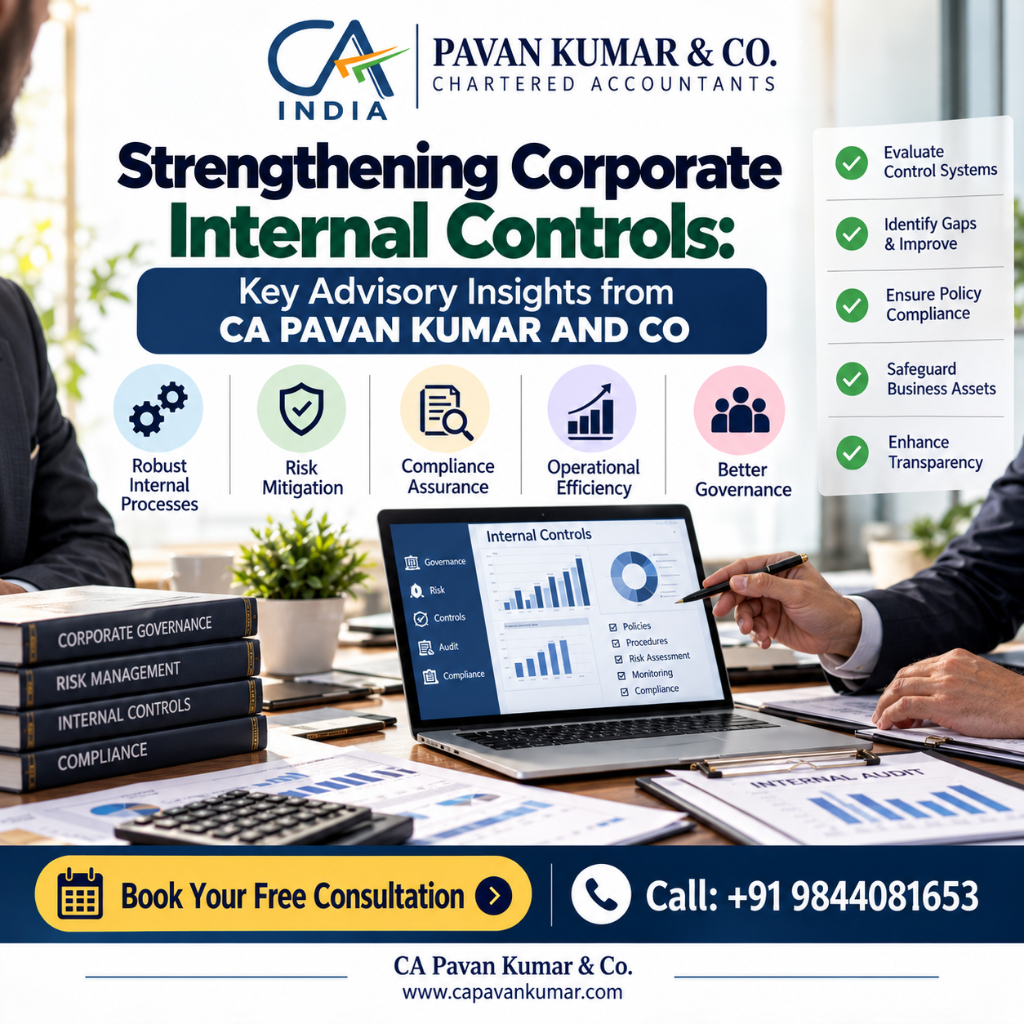
Effective financial controls enable businesses to more efficiently and effectively utilize resources, and reinforce compliance. As a company continues to evolve and grow, its financial processes become increasingly complicated and involve more employees, vendors, bank accounts, and software systems.
An internal financial control audit helps to ensure effective oversight and examines how properly designed financial controls are implemented and operating within defined limits.
When a company is seeking IFC audit Bangalore services, the objective is not to simply identify financial errors and exceptions. Effective planning in advance can assist the management team in determining the types of risks and controls in the financial reporting process and where there may be opportunities for improving financial process controls and effectiveness.
The Institute of Chartered Accountants of India (ICAI) describes internal controls as processes that enable achievement of business objectives, reliability of financial reporting, compliance and safeguarding of assets. The guidance also connects the internal financial controls over financial reporting to the risk assessment principles as discussed in SA 315.
An internal financial control audit generally involves reviewing and testing controls related to the following:
– Authority and approvals for payments
– Conflict of interest in authorization and approval of transactions
– Review of bank reconciliations
– Documentation support for accounting entries
– User access controls on financial systems
– Transactions outside the normal course of business
– Periodic reconciliation of financial records
The objective of the engagement is to perform a structured assessment of the control environment within the scope of the engagement.
According to the ICAI, internal controls in an organization can assist in achieving the objectives of effectiveness and efficiency in operations, and also in reliability of financial reporting, compliance and safeguarding of assets.
ICAI Knowledge Base
Why Do Internal Financial Controls Matter?
A business may have accurate accounting software and still have weak controls.
For example, if the same person can create a vendor, approve an invoice, and release payment without independent review, the system may contain a control weakness even though every transaction is recorded.
-Strong controls can help a business:
-Reduce errors in financial statements
-Ensure reliable financial information
-Strengthen approval and authorization of transactions
-Protect company’s assets
-Increase accountability
-Aid compliance
-Identify and react to unusual transactions
Define responsibilities
Internal controls should be viewed as part of business management process rather than a mere formality for the audit.
Who Can Benefit From an IFC Review?
Growing Companies
As the volume of transactions increase, an informal approval process may break down. A review of controls may help growing companies formalize responsibilities.
Start-Ups
Start-ups may have a strong focus on product development, sales and fund raising, with little attention to the evolution of processes for financial control as the company grows.
Small and Medium Businesses
A heavy reliance on a small number of employees for accounting and financial administration may result in a concentration of responsibilities and limited segregation of duties.
Established Enterprises
Larger companies may have multiple locations and systems. Control reviews help management assess whether processes remain consistent across the company.
Companies Seeking Investment or Expansion
As companies prepare to raise new capital, lenders and other stakeholders may have expectations on the company to have adequate financial processes and controls.
The scope and depth of an internal controls review depends on the objectives of the review and the laws applicable to the company.
1. Revenue and Receivables
Reconciliation of sales and receivables process may include review of controls on sale authorization, credit approval, invoicing, collection and reconciliation of accounts receivables.
Questions may focus on the existence of controls on authorization of sales and on review of accounts receivables at specified period.
2. Purchases and Payments
Procurement and payment processes touch the cash of the organization and its external parties. Therefore, it is equally important to have sufficient controls in these processes.
The review may cover controls of:
-Vendor setup
-Approval of purchase
-Issuance of purchase order
-Examination of invoice
-Approval of payment
-Master file of vendors
-Bank payment processes
3. Bank and Cash Management
Controls in cash and bank may include cash handing controls, the authorization to access and to make payment.
4. Payroll
Controls may extend to the master file of employees, approval of salary, attendance, statutory deductions and processing of payroll.
5. Fixed Assets
Business should maintain the records of its important business assets and have processes to ensure movement of the assets. Also, the business should have processes for depreciation of the assets and their disposal.
6. Financial Close and Reporting
The monthly and year end closing processes should include adequate review and reconciliation to support the reports prepared.
Controls over journal entries, account reconciliations, and financial reporting is critical in the preparation of management reports.
Building a Risk Management Framework
Working internal controls framework with a risk management framework of the organization provides a greater assurance to the control environment of the organization.
A business can begin with the identification of its material financial and operational risks. Some of these risks and example controls are illustrated below.
-Payments unauthorized payment approvals
-Revenue unauthorized sale inventory and sales reconciliation
-Payroll incorrect employee payment independent payroll review
-Bank unauthorized access role based authorization
-Inventory unrecorded movement periodic physical verification
The appropriate control varies based on a company’s size, industry, systems, and risk profile.
ICAS audit guidance states audit professionals should consider an entity’s understanding of its environment, including the applicable reporting framework, business model, and IT environment when assessing financial reporting risks.
-CA Journal
-Vendor and customer master data
– Approval matrices
– Payroll records
– Fixed-asset registers
-Inventory records
-IT access and authorization records
-GST and tax-related reconciliations
-Past audit reports
-Internal audit observations, if any.
Providing accurate and complete information helps the professional in appreciating the control environment.
Common Internal Control Mistakes
Excessive Reliance on One Person
When a person controls too many steps of a transaction, there is risk of not segregating duties.
No Independent Review
Transactions of an important nature must be reviewed and authorized by a person based on the risk profile of the business.
Weak User Access Controls
Past employees or staff who have been replaced must not have access to business systems.
Manual Reconciliations Without Review
Reconciliations become useful only when the differences, if any, are investigated and the reconciliation is reviewed.
Policies Which Are Not Followed
Management must verify whether the actual process flows and documentation are aligned.
Treating Controls as a One-Time Exercise
Business processes, technology, risks and the workforce are in continuous flux, and control activities must keep pace.
Benefits of Professional Internal Control Support
An experienced CA internal controls professional can support the business in strengthening its control environment.
Potential benefits include:
-Assessment of key processes by an independent third party
-Identification of gaps in controls
-Enhanced discipline in financial reporting
-Clarity in approval responsibilities
-Improved documentation
-heightened management awareness of risks
-Improved co-ordination between management and the accounts team
-Practical recommendations to improve business processes
This is more about management establishing and assessing the necessary controls associated with the identified risks.
Why Choose Pavan Kumar & Co?
Pavan Kumar & Co is a Chartered Accountant firm based in Seshadripuram, Bengaluru. The current website covers tax compliance and advisory services, GST compliance, audit, accounting, corporate and LLP compliance as well as business and compliance advisory.
The firm has expertise in statutory and tax, and internal audits.
Businesses looking for IFC audit Bangalore support would find the integration of the firm’s accounting, audit, taxation and compliance, as well as its expertise in GST, accounting and payroll records, tax compliance and financial reporting, to be of benefit.
Pavan Kumar & Co works with corporates, startups, LLPs, professionals and individuals.
Its Seshadripuram location provides it access to businesses in Bangalore and other parts of India.
Frequently Asked Questions
1. What is an internal financial control audit?
An internal financial control audit is a structured examination of controls relevant to financial reporting and related financial processes. It assesses whether controls are appropriately designed and, where applicable, operating effectively within the defined scope.
2. Is an internal financial control audit mandatory for every business?
No single answer applies to every business. Requirements can depend on the company’s type, applicable provisions of the Companies Act, relevant rules and the nature of the audit engagement. Companies should obtain professional advice based on their specific circumstances. ICAI identifies Section 143(3)(i) of the Companies Act, 2013 as a statutory basis for auditor reporting on internal financial controls over financial reporting in applicable circumstances. IICAI
3. How often should internal controls be reviewed?
The appropriate frequency depends on the organization’s size, complexity, risk profile, regulatory requirements and changes in its processes. Controls should also be reassessed when there are major changes in systems, personnel, business activities or organizational structure.
4. What is the difference between internal audit and IFC audit?
The scope can differ. An internal audit may cover broader operational, financial, compliance and risk areas, while an IFC review focuses specifically on internal financial controls within its defined scope. The terms should therefore not be treated as interchangeable without considering the engagement objectives.
5. Can an internal control audit prevent fraud?
Strong controls can help reduce opportunities for errors and unauthorized activity and may support earlier detection of irregularities. However, no control system can guarantee that fraud or misconduct will never occur.
Strengthen Your Business Controls With Professional Support
As a company grows, financial controls need to grow with it. Clear approval processes, appropriate segregation of duties, reconciliations, access controls and management reviews can help create a more disciplined financial environment.
For companies in Bangalore, including Seshadripuram, as well as startups, small businesses and growing enterprises across India, a structured internal financial control audit can provide useful insight into whether important financial processes are working as intended.
The right approach depends on the company’s structure, applicable regulations, existing systems and specific risks. A qualified CA can help determine the appropriate scope and methodology.
Get an appointment to speak with our expert team and discuss your accounting and compliance requirements.
Pavan Kumar & Co.
Sannidhi, 26, RK Street, Jai Bheema Nagar, Seshadripuram, Bengaluru, Karnataka – 560020
Call: +91 9844081653
Email: capavankumars@gmail.com
This blog is for educational purposes only and should not be treated as tax, legal, or financial advice. Please consult a qualified chartered accountant for advice based on your specific situation.