You currently stand in the early steps of building a startup. You possess a solid founding team and a great product iteration. Now, you need funds to hit your launch. Consequently, an angel investor offers you ₹50 Lakhs.
However, you face an awful question: “What is your company’s valuation?”
This answer requires a delicate balance. If you value too low, you lose excessive control via dilution. Alternatively, a valuation that is too high might scare investors away. Thankfully, Silicon Valley developed two brilliant ideas: Convertible Notes and SAFE Agreements. These tools allow founders to accept investment now. Simultaneously, they push the difficult valuation argument into the future.
However, a major problem exists.
These ideas work seamlessly in the US. In India, they collide with the regulatory system managed by the Ministry of Corporate Affairs (MCA) and the Reserve Bank of India (RBI). At CA Pavan Kumar & Co., we often see founders using international templates. Sadly, they copy and paste these from the internet. Consequently, they violate Indian corporate law.
If you decide to use Convertible Notes or SAFEs in India, you must understand the following reality.
1. The Convertible Note (CN): A Loan in Disguise
Essentially, a Convertible Note acts as a short-term loan. Eventually, this loan converts into equity shares during your next funding round.
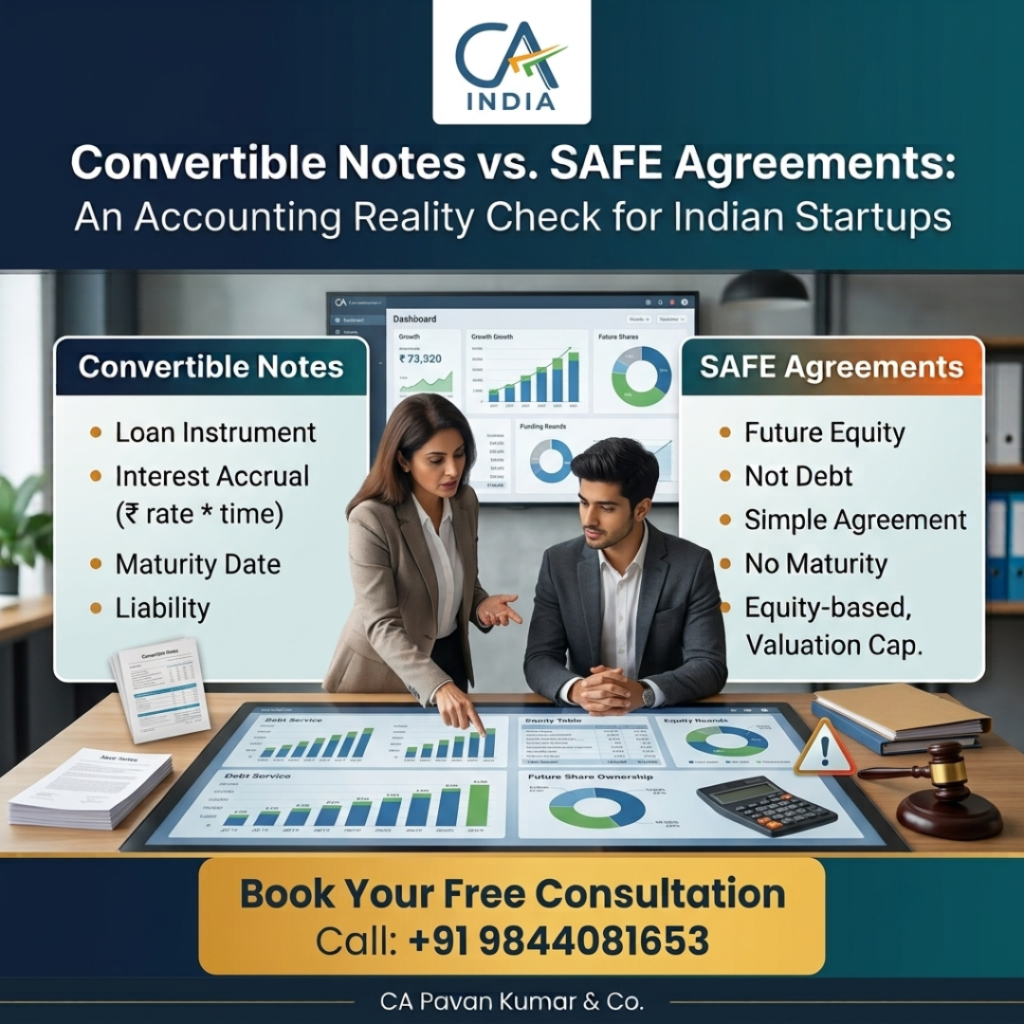
- The Process: You receive ₹50 Lakhs. Crucially, the investor does not receive shares yet. Instead, the investor receives a promise. In the event of a priced round, their investment converts to shares at a discount. Typically, this discount is 20% less than the price paid by new investors. Furthermore, it often includes a Valuation Cap.
- The Indian Legal Reality: Under the Companies Act, borrowing from anyone besides a Bank or Director is challenging. The law treats such loans as “public deposits.” Therefore, to issue a Convertible Note legally, your company must receive recognition as a “Startup” by the DPIIT.
- The Restrictions: Furthermore, the investment must total at least ₹25 Lakhs. Finally, the Note must convert to equity within 10 years.
2. The SAFE Agreement (And the Indian “iSAFE”)
Y Combinator endorsed the SAFE (Simple Agreement for Future Equity). They invented it to be even simpler than a Convertible Note.
- The Global View: A standard SAFE does not constitute debt. Furthermore, it carries no interest and no maturity date. It simply acts as a future request to receive shares.
- The Indian Reality: An equivalent to the standard SAFE does not exist in the Indian legal system. If you accept money but fail to issue shares or debt within 60 days, you face a violation.
- The Fix (iSAFE): To adapt, legal professionals introduced the iSAFE. From an accounting perspective, the iSAFE represents Compulsorily Convertible Preference Shares (CCPS).
3. The Accounting Dilemma: Debt or Equity
Your accounting department cannot label “Angel Money” on the balance sheet. Instead, we must classify it accurately. This classification subsequently affects your financial ratios.
- Convertible Notes: Because these are debt instruments, they remain on the balance sheet as liabilities until they convert. Consequently, your company appears highly indebted. This might concern traditional banks if you require a working capital loan.
- iSAFEs (CCPS): Because the iSAFE functions as a structured preference share in India, it appears as equity. Therefore, this improves your balance sheet. Ultimately, it makes your company appear more solvent.
4. The Foreign Investor Issue (FEMA Compliance)
If your investor resides in San Francisco or Singapore, you cannot simply sign documents and wait for the cash.
The RBI enforces strict regulations for Foreign Direct Investment (FDI).
- The Requirement: If you offer iSAFEs to foreign investors, pricing regulations apply. Specifically, the conversion price cannot fall below the Fair Market Value (FMV) on the issuance day.
- The Implication: Therefore, you still need a valuation report from a Chartered Accountant or Merchant Banker on day one. Sadly, this partially negates the idea of “delaying the valuation.”
Protect Your Cap Table Before Signing
A Y Combinator SAFE template paired with an Indian investor will result in a compliance crisis. Specifically, you risk trouble with the Registrar of Companies (ROC).
At this stage of the investment cycle, you must exercise extreme caution. You must choose financing options that protect your equity. Furthermore, you must ensure compliance with Indian corporate law.
Before you sign a Term Sheet, let our Virtual CFO team brace your Convertible Notes or iSAFEs. We will strengthen your compliance and your cap table.
Book your appointment today:
- Website: https://capavankumar.com/
- Phone: +91 9844081653
- Email: capavankumars@gmail.com