
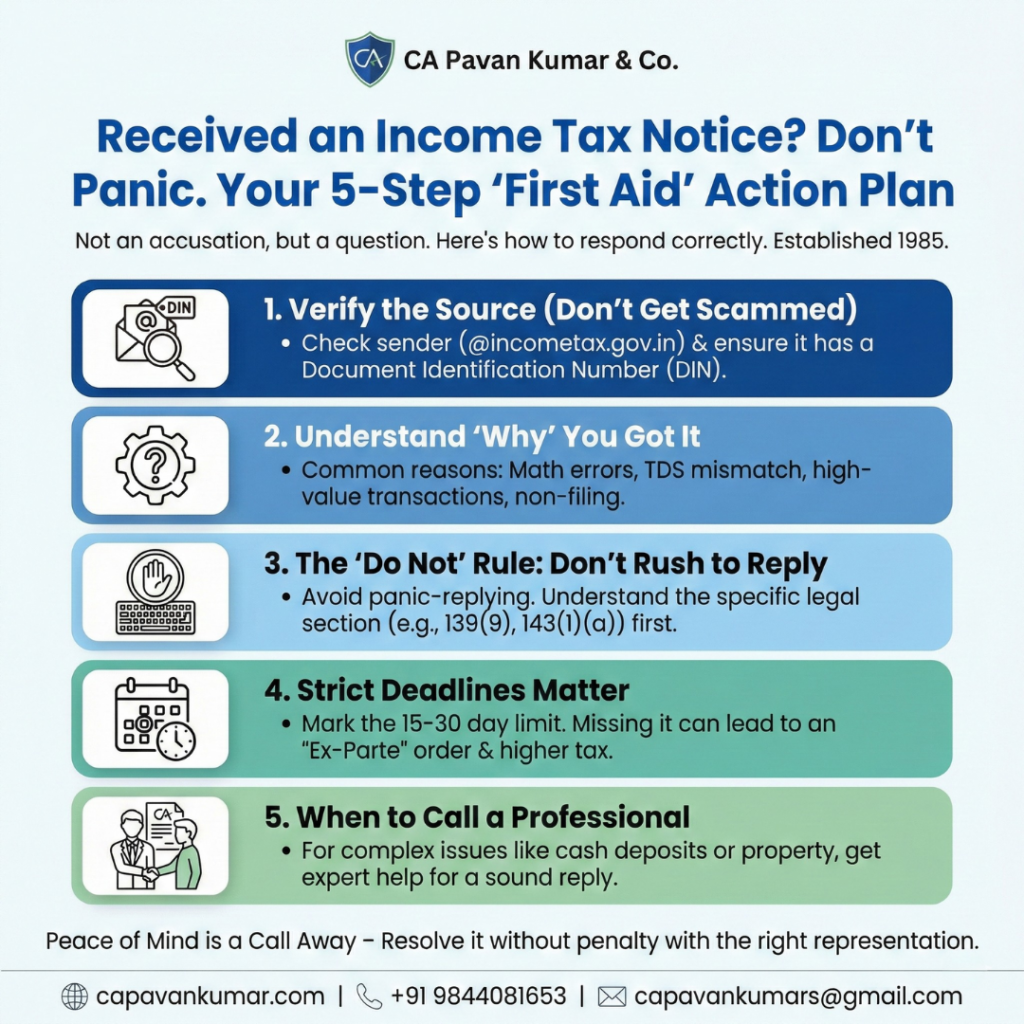
Your phone buzzes. You check your email. There it is—an email from the Income Tax Department with the subject line “Notice under Section…”
Your stomach drops. Your mind races. Am I in trouble? Did I commit a crime? Is this an audit?
First: Take a deep breath.
Receiving a notice does not automatically mean you have done something wrong. In the age of automated data processing, notices are becoming more common, often generated by computer systems simply clarifying a mismatch in numbers.
However, ignoring it is dangerous. At CA Pavan Kumar & Co., we handle hundreds of these notices every year. Here is your immediate “First Aid” guide on what to do (and what NOT to do).
1. Verify the Source (Don’t Get Scammed)
Before you worry, check if the notice is real. Scammers often send fake tax emails to steal data.
- Check the Email ID: Real notices come from official domains, such as @incometax.gov.in.
- Look for the DIN: Every valid notice issued by the Income Tax Department must include a Document Identification Number (DIN). If there is no DIN, the notice might be invalid.
2. Understand “Why” You Got It
Most notices aren’t accusations; they are questions. The most common reasons include:
- Mathematical Errors: A simple calculation mistake in your return.
- TDS Mismatch: Your employer deducted tax, but it doesn’t match what is shown in your Form 26AS.
- High-Value Transactions: You bought a property or made a large credit card payment that doesn’t match your reported income.
- Non-Filing: You forgot to file a return, and the government knows you had taxable income.
3. The “Do Not” Rule: Don’t Rush to Reply
The biggest mistake people make is panic-replying. They log into the portal and hastily type an explanation without understanding the specific legal section mentioned in the notice.
- Section 139(9): Defective Return (usually fixable).
- Section 143(1)(a): Intimation of arithmetic error.
- Section 148: Income escaping assessment (Serious).
A wrong reply can come back to haunt you later. It is vital to understand exactly which section you are dealing with before responding.
4. Strict Deadlines Matter
A notice always comes with a time limit—usually 15 to 30 days.
- Action: Mark this date on your calendar immediately.
- Consequence: If you don’t respond by the deadline, the officer can pass an “Ex-Parte” order—meaning they will decide your tax liability without hearing your side of the story. This almost always results in a higher tax demand.
5. When to Call a Professional
If the notice asks for a simple correction (like a wrong challan number), you might handle it yourself.
But if the notice asks for explanations of cash deposits, property sources, or discrepancies in income, do not attempt to DIY. You need a Chartered Accountant to draft a legally sound response that closes the matter once and for all.
Peace of Mind is Just a Call Away
A tax notice is not a verdict; it’s just the start of a conversation. With the right representation, most notices are resolved without any penalty.
Got a notice? Don’t guess the answer. Contact CA Pavan Kumar & Co. – Forward the email to us, and we will tell you exactly what it means and how to fix it.
Schedule your appointment now by visiting our website https://capavankumar.com/
📞 Call us: +91 9844081653
📧 Email: capavankumars@gmail.com