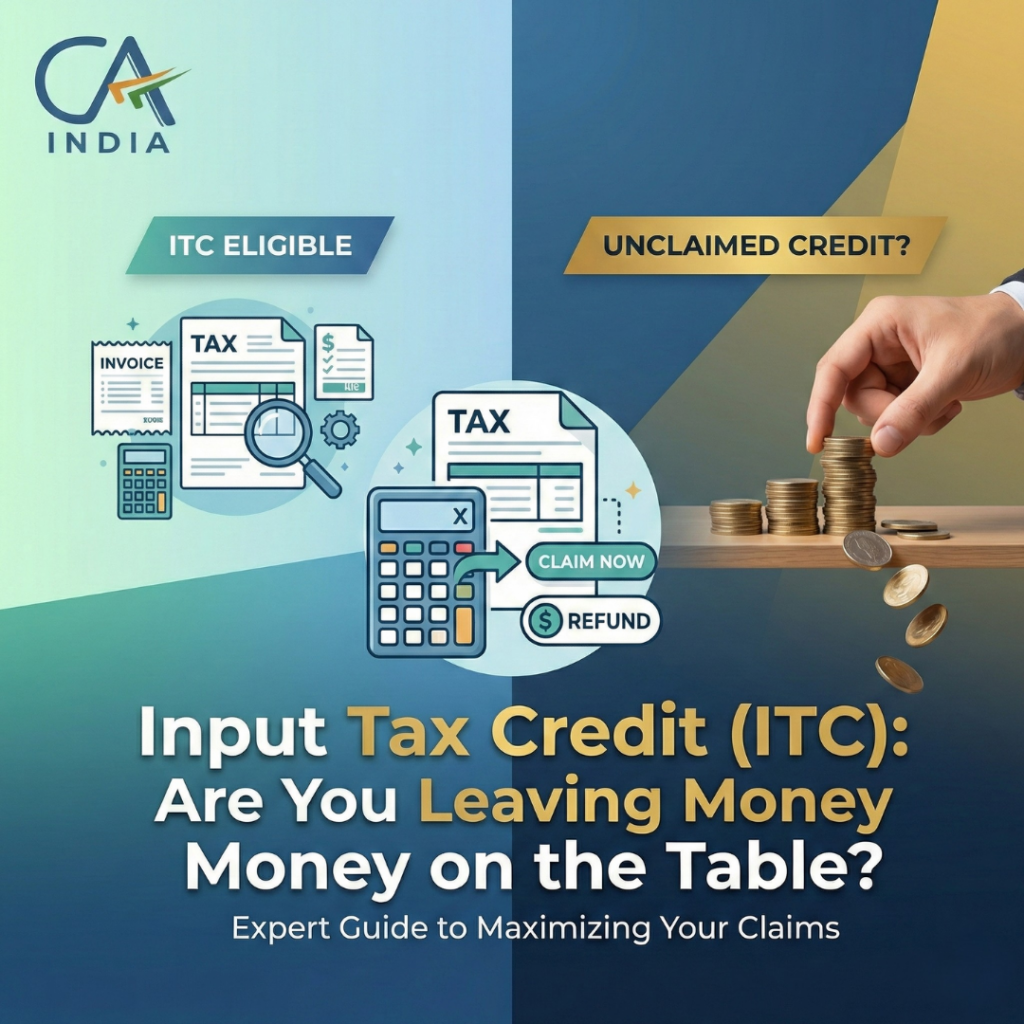
Imagine walking down the street and dropping a ₹500 note. You would probably stop, look around, and try to find it, right? Now, imagine doing that every single month.
For many businesses in India, unclaimed Input Tax Credit (ITC) is precisely that—money dropped on the floor that is never picked up.
At CA Pavan Kumar & Co., we often see businesses focusing purely on sales while ignoring their purchases. But in the GST regime, your purchases are just as important. If you aren’t claiming your ITC correctly, you are artificially inflating your costs and lowering your profit margin.
Here is how to ensure you get every rupee you are owed back.
1. What is ITC Really? (The “Offset” Mechanism)
Let’s keep it simple. When you buy raw materials, pay office rent, or buy a laptop for business, you pay GST on them. That GST amount is not an expense. It is an asset. It sits in your “Electronic Credit Ledger” like a digital wallet balance. When you have to pay tax on your own sales, you can use this balance to pay it instead of using cash from your bank account.
- If you pay ₹10,000 tax on a laptop and your sales tax liability is ₹15,000, you only pay ₹5,000 in cash.
2. The Crucial “Section 16” Conditions
Just because you paid GST doesn’t mean you automatically get the credit. You must satisfy 4 rigid conditions:
- The Paper: You must have a valid Tax Invoice or Debit Note.
- The Goods: You must have actually received the goods or services. (No fake billing allowed!)
- The Payment: Your supplier must have actually paid that tax to the government.
- The Filing: You must have filed your own GST return.
3. The Hidden Trap: “My Supplier Didn’t Pay.”
This is where 90% of disputes happen. You paid your supplier. You have the invoice. You have the goods. But if your supplier fails to file their GSTR-3B return, the government will deny YOU the credit.
It seems unfair, but that is the law. You cannot claim credit for tax that hasn’t reached the government. The Fix: Don’t just unquestioningly pay vendors. Check if they are filing their returns. If they are non-compliant, hold their payment!
4. The “GSTR-2B” Reconciliation Ritual
Every month, the GST portal generates a statement called GSTR-2B. This is the “Truth Source.” If an invoice appears in your GSTR-2B, you can claim credit. If it doesn’t appear (because the vendor delayed filing), you cannot claim it yet.
Pro Tip: Make reconciliation a monthly habit. Before filing your GSTR-3B on the 20th, compare your purchase register with GSTR-2B. Chase the vendors who are missing.
5. Items You CANNOT Claim (Blocked Credit)
Be careful. You cannot claim ITC on everything. Under Section 17(5), credit is “blocked” for:
- Food and beverages (e.g., office lunch expenses).
- Personal use items.
- Construction of immovable property (office building).
- Motor vehicles (unless you are in the transport business).
Claiming these by mistake will lead to notices and interest penalties later.
Stop Bleeding Cash
Input Tax Credit is your money. Don’t let lazy vendors or messy paperwork take it away from you. A robust reconciliation process can save a small business lakhs of rupees a year.
Is your ITC matching your 2B? Contact CA Pavan Kumar & Co. We help you reconcile your books and recover every penny of legitimate credit
Schedule your appointment now by visiting our website https://capavankumar.com/
📞 Call us: +91 9844081653
📧 Email: capavankumars@gmail.com