
If you are a salaried employee in India, you probably know Section 80C by heart.
It’s the first thing everyone talks about. You buy your life insurance, invest in PPF, show your children’s tuition fees, and—snap—you hit the ₹1.5 Lakh limit.
But then you look at your taxable income, and it still looks high. You might think, “Is this it? Is this the maximum I can save?”
The short answer is: No.
At CA Pavan Kumar & Co., we often see clients leave thousands of rupees on the table simply because they stop taking care of Section 80C. The Income Tax Act is vast, and several “hidden” pockets of savings are 100% legal and highly effective.
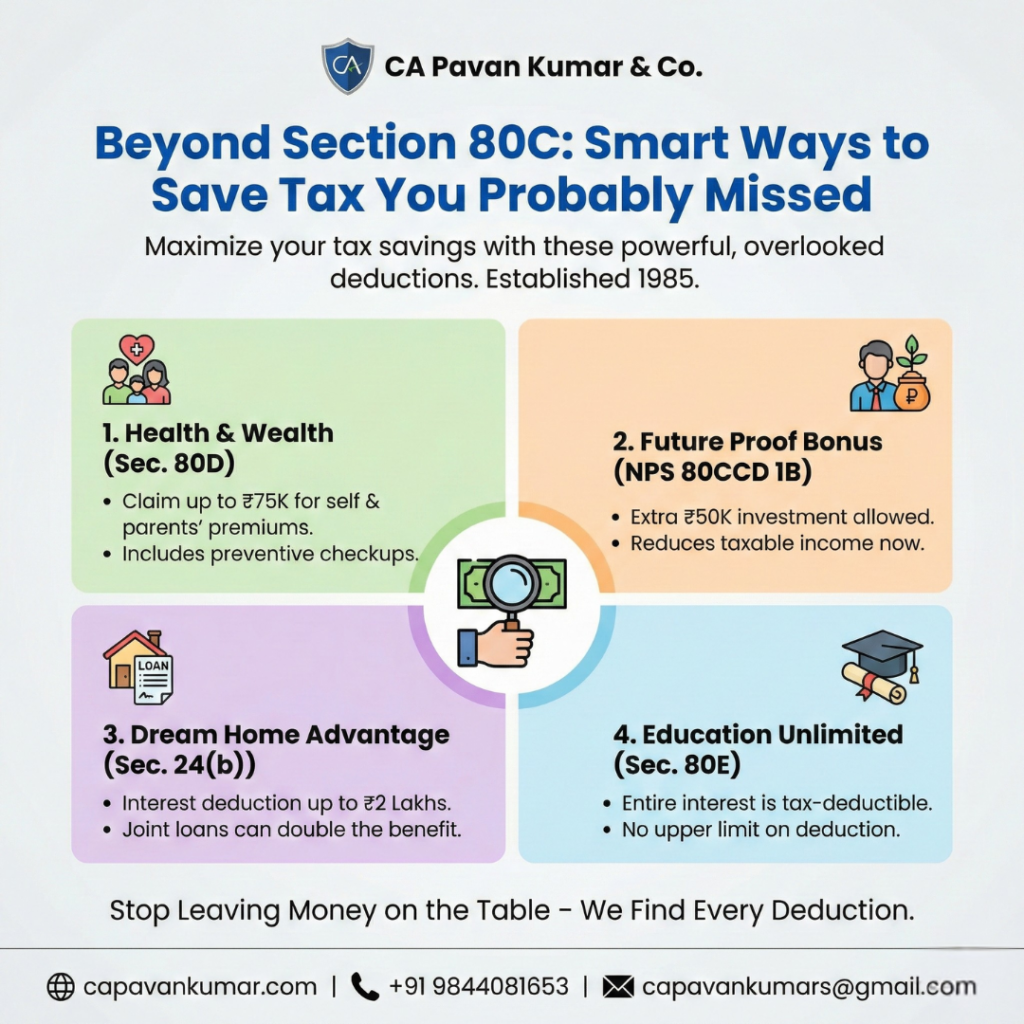
Here are 4 smart ways to save tax that go beyond the usual 80C limit.
1. The “Health & Wealth” Saver: Section 80D
Most people buy health insurance to stay safe during medical emergencies. But did you know it’s also a powerful tax tool?
- For Yourself & Family: You can claim up to ₹25,000 for premiums paid for yourself, your spouse, and your children.
- For Your Parents: This is the big one. If you pay health insurance premiums for your parents (senior citizens), you can claim an additional ₹50,000.
The Bonus: Even if your parents don’t have a policy, you can claim up to ₹5,000 for their preventive health checkups. Don’t lose those receipts!
2. The “Future Proof” Bonus: NPS (Section 80CCD 1B)
This is arguably the most underutilised section in the tax book.
Over and above your ₹1.5 Lakh 80C limit, the government allows you to invest an additional ₹50,000 in the National Pension System (NPS). This is a dedicated retirement fund.
By investing this extra amount, you aren’t just saving for your golden years; you are also reducing your taxable income by an additional flat ₹50,000 right now.
3. The “Dream Home” Advantage: Section 24(b)
If you are paying an EMI on a home loan, you have a massive advantage.
While the principal repayment falls under the crowded 80C bucket, the interest you pay on your home loan is deductible under Section 24(b) up to ₹2 Lakhs per year (for a self-occupied property).
Note: If you have a joint loan with your spouse, both of you can claim this deduction separately, doubling the benefit!
4. The “Education” Unlimited: Section 80E
Most tax deductions have a cap. Section 80E does not.
If you have taken an education loan for yourself, your spouse, or your children, the entire interest amount you pay is tax-deductible. There is no upper limit, such as ₹1.5 Lakh or ₹2 Lakh. Whether you pay ₹50,000 or ₹5 Lakhs in interest this year, it can all be deducted from your taxable income for up to 8 years.
Stop Leaving Money on the Table
Tax planning isn’t just about ticking boxes on a form; it’s about looking at your entire life—your health, your home, your family, and your future—and structuring it smartly.
If you are paying more tax than you should, you probably are.
Let’s review your portfolio together. Contact CA Pavan Kumar & Co. – We help you find every legitimate deduction you deserve.
Schedule your appointment now by visiting our website https://capavankumar.com/
📞 Call us: +91 9844081653
📧 Email: capavankumars@gmail.com