
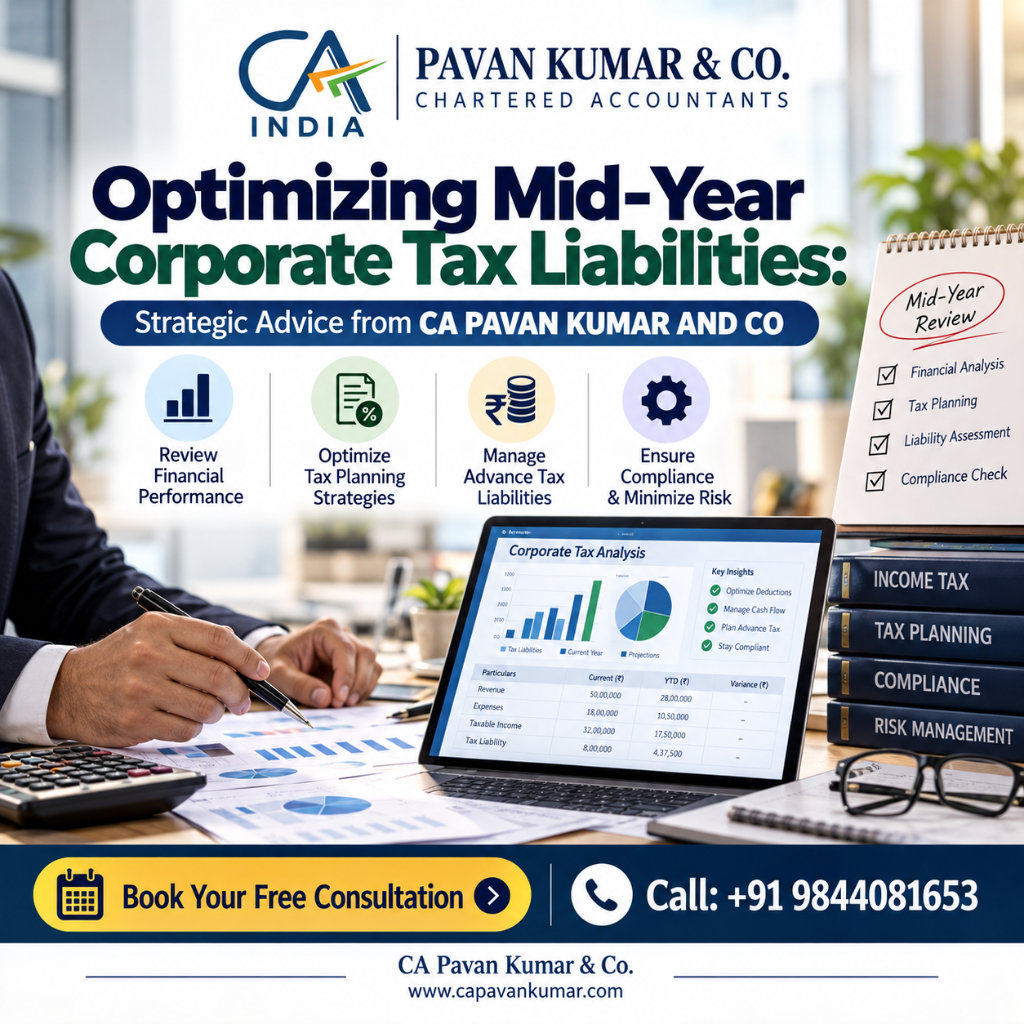
Planning for taxes shouldn’t start just before the end of the financial year. A mid-year assessment enables companies to measure their actual performance against the projections, adjust their expected tax exposure and close any compliance gaps which exist but can still be remedied.
Outstanding tax planning services in Bangalore can help companies evaluate their anticipated taxable income, their position on advance tax, eligible deductions, TDS and accounting before the demands of business and taxes collide at year end.
Ultimately, companies, start-ups, small businesses and growing enterprises, have the objective of optimally and legally managing their tax exposure. This enables them to achieve their goals and make compliant decisions without incurring penalties, interest and unexpected surprises.
This is more applicable for the year 2026 as India’s tax regime has moved to the Income Tax Act, 2025 from 1st April, 2026, and earlier assessment years will continue to be governed by the previous laws. Therefore, for the review, businesses will have to consider the tax year and relevant provisions. Income Tax Department+1
What Is Mid-Year Corporate Tax Planning?
Mid-year corporate tax planning, simply put, is an assessment of a company’s expected income, expenses, deductions and tax payments and compliance before the end of the financial or tax year.
– Pending tax notices or disputes
We look to identify issues as they arise in order to make the most informed decisions based on the company’s actual financial position.
Companies looking for corporate tax planning in Bangalore can particularly benefit from this procedure where the company’s profits, investments or business situation has changed significantly during the year.
Who Should Consider a Mid-Year Tax Review?
Established Companies
Companies should reassess estimated tax liabilities when they experience unexpected increase in profits rather than blindly following the estimates done at the start of the year.
Startups and Growing Companies
Rapid changes in startup’s revenue, expenses, funding, hiring and capital expenditure need to be synchronized with the changes in the business. Mid-year tax and accounting review achieves this.
Small Businesses
Limited resources are stretched across multiple areas in small businesses. A review at periodic intervals by a third party professional can address gaps and oversights.
Businesses that Have Done a Lot of Transactions
Any major purchase of assets, investment, restructuring or related party transactions or international transactions warrant an early review of tax and compliance.
Key Areas to Review Mid-Year
1. Recalculate the Expected Tax Position
Rather than using the annual forecast, which may be outdated, use the latest management accounts and reflect:
– Revenue
– Operating Expenses
– Depreciation
– Other Income
– Capital Gains, if any
– One time or exceptional items
– Expected revenue for the balance period
This may provide a better indication on tax exposure.
2. Advance Tax Payments
Comparisons should be made between advance tax and the latest estimate of the company’s tax liability.
According to the Income Tax Department, advance tax obligations will continue under the new framework and the provisions will apply to income of the tax year 2026-27. Income Tax Department
Ofcourse the exact amount and due dates depend on the individual circumstances of the taxpayer. Therefore, businesses should compare taxes already paid to the latest estimate of the company’s tax liability as opposed to blindly repeating previous estimates.
A review in Q3 can be especially useful when there have been large changes to the company’s profits for the period. Hence, advance tax planning in Q3 can be part of a year-round tax management process.
3. Check TDS Compliance
As part of a company’s tax position, TDS can also be important.
Companies should check to see whether:
a) The TDS has been correctly identified.
b) TDS has been deducted at the proper time.
c) TDS has been deposited within the time limit.
d) Correct reports have been submitted.
e) Reconciliation has been done with the accounts.
As part of its ongoing guidance, the Income Tax Department stipulates quarterly reporting of TDS statements with various forms and time limits, depending upon the nature of the TDS.
Differences identified through a reconciliation can help avoid larger compliance problems.
4. Review Tax Deductible Expenses and Documentation
Companies should verify that expenses which are allowed under the tax law and are bona fide business expenses are supported by relevant documents.
Creating a transaction merely to reduce the tax liability is not allowed and is illegal.
In order to verify that a transaction has been properly recorded, companies should review the supporting business documents to include relevant agreements, invoices, payment records, etc.
The reviews analyzed here are sensible tax saving strategies as part of individual income tax planning, but income tax planning should always be based on real-world transactions and supported by the provisions of the law.
5. Review Capital Expenditure and Depreciation
If your business has purchased or is in the process of purchasing capital assets, the timing and tax impact of that purchase should be assessed with your tax professional.
Assets are treated differently for accounting and tax purposes, and companies should not base their investment decisions on tax factors.
A Practical Mid-Year Tax Planning Process
Step 1: Obtain Updated Financial Information
Prepare up-to-date financial statements, bank statements and supporting schedules.
Step 2: Analyze Actuals vs. Budget
Identify differences between actuals and budget. For instance, you may have realized higher revenues and, if costs haven’t increased, your taxable income may also have increased.
Step 3: Restate Taxable Income
Look at the tax impact of increased revenues and profitability.
Step 4: Adjust Tax Payable and Paid
Review your records for advance tax payments and TDS against tax credits.
The Income Tax Department has stated that information relating to TDS and advance tax payments is available in the Annual Information Statement and related systems.
Step 5: Assess Compliance
Review GST, tax returns and other records.
Step 6: Plan The Rest Of The Year
Once the situation is clear, management can make informed decisions regarding expenses, investments and cash flow, and make strategic decisions regarding tax payments.
Common Corporate Tax Planning Mistakes
Waiting Until Year-End
Planning at year-end gives little time to correct accounting and/or documentation issues.
Treating Tax Planning As Tax Avoidance
Legitimate tax planning is based on the law. Artificial arrangements can lead to risks and expose the business to compliance issues.
Ignoring TDS Reconciliation
A discrepancy between records and tax information can complicate things.
Relying on Old Tax Assumptions
Tax laws are amended and companies should review the recent amendments to verify the rules for the relevant tax year.
Making Decisions Only for Tax Benefits
There should be a legitimate commercial reason for the company to undertake a transaction.
Tax Review- Related Documents
The Chartered Accountant may review the following documents:
– Most recent trial balance
– Profit and Loss account
– Balance Sheet
– Bank Statements
– Fixed Assets list
– Expense records/receipts
– Sales and Purchase registers
– GST return and reconciliations
– TDS records/certificates
– Advance Tax Challans
– AIS and relevant Tax Statements
– Details of investments and major transactions
– Previous tax returns and assessments
– Details of notices or litigations
The documents required depend on the company’s transactions and compliance obligations.
Benefits of Professional Tax Advisory Support
Engaging a professional Tax Advisory CA can assist businesses in planning their tax effectively and assure compliance.
Pros of selecting Pavan Kumar & Co
Pavan Kumar & Co is a chartered accountancy firm established in 1985, providing tax, GST, accounting, audit, business registration, payroll, TDS, litigation, NRI taxation and financial advisory services. They provide support for tax, GST, accounting and auditing, payroll and TDS, NRI, taxes and litigation and financial advisory services. They have a team of professionals with extensive experience in diverse industries. Their focus is on individuals and small and medium enterprises. They provide outsourced CFO and/or Company Secretary services. Their clients include commercial establishments, service providers, industrial units, trading houses, professional organizations and financial institutions. They employ detailed checklists for each engagement and status reports are provided to clients on weekly/ fortnightly/monthly basis. They use stress-free, accurate and transparent methods to assist clients in compliance.
Businesses can require a combined CA/tax support for corporate tax planning in Bangalore as tax planning spans across accounting and GST, payroll and other financial decisions. They are based in Bangalore and can assist clients locally as well as in other parts of India.
Frequently Asked Questions
1. What is corporate tax planning?
Corporate tax planning is the process of reviewing a company’s projected taxable income, applicable tax provisions, deductions, payments and compliance obligations so that legitimate tax and financial decisions can be made in advance.
2. When should a company review its advance tax position?
A company should periodically compare its actual financial performance with its earlier tax estimates. A Q3 review can be particularly useful when profits or major transactions have changed materially.
3. What documents are needed for corporate tax planning?
Common documents include financial statements, trial balance, bank records, GST returns, TDS records, advance tax challans, fixed-asset schedules and information about significant transactions. Requirements vary by company.
4. Can tax planning eliminate a company’s tax liability?
No. Tax planning does not guarantee that tax will be eliminated or reduced to a particular amount. The final liability depends on the company’s income, applicable provisions, deductions, transactions and compliance position.
5. Can a CA help with both tax planning and compliance?
Yes. A CA can assist with areas such as tax planning, tax filing, accounting, GST, TDS, audit support and tax-related notices, depending on the firm’s services and the client’s requirements.
Consult CA Pavan Kumar & Co for Strategic Tax Planning
Mid-year tax planning is most useful when it is treated as part of the company’s broader financial management rather than as a last-minute year-end exercise.
For businesses in Bangalore, including Seshadripuram, and for startups, small businesses, growing enterprises, individuals and NRIs across India, a professional review can help bring tax, accounting and compliance information together
Get an appointment to speak with our expert team and discuss your accounting and compliance requirements.
Pavan Kumar & Co.
Sannidhi, 26, RK Street, Jai Bheema Nagar, Seshadripuram, Bengaluru, Karnataka – 560020
Call: +91 9844081653
Email: capavankumars@gmail.com
This blog is for educational purposes only and should not be treated as tax, legal, or financial advice. Please consult a qualified chartered accountant for advice based on your specific situation.