
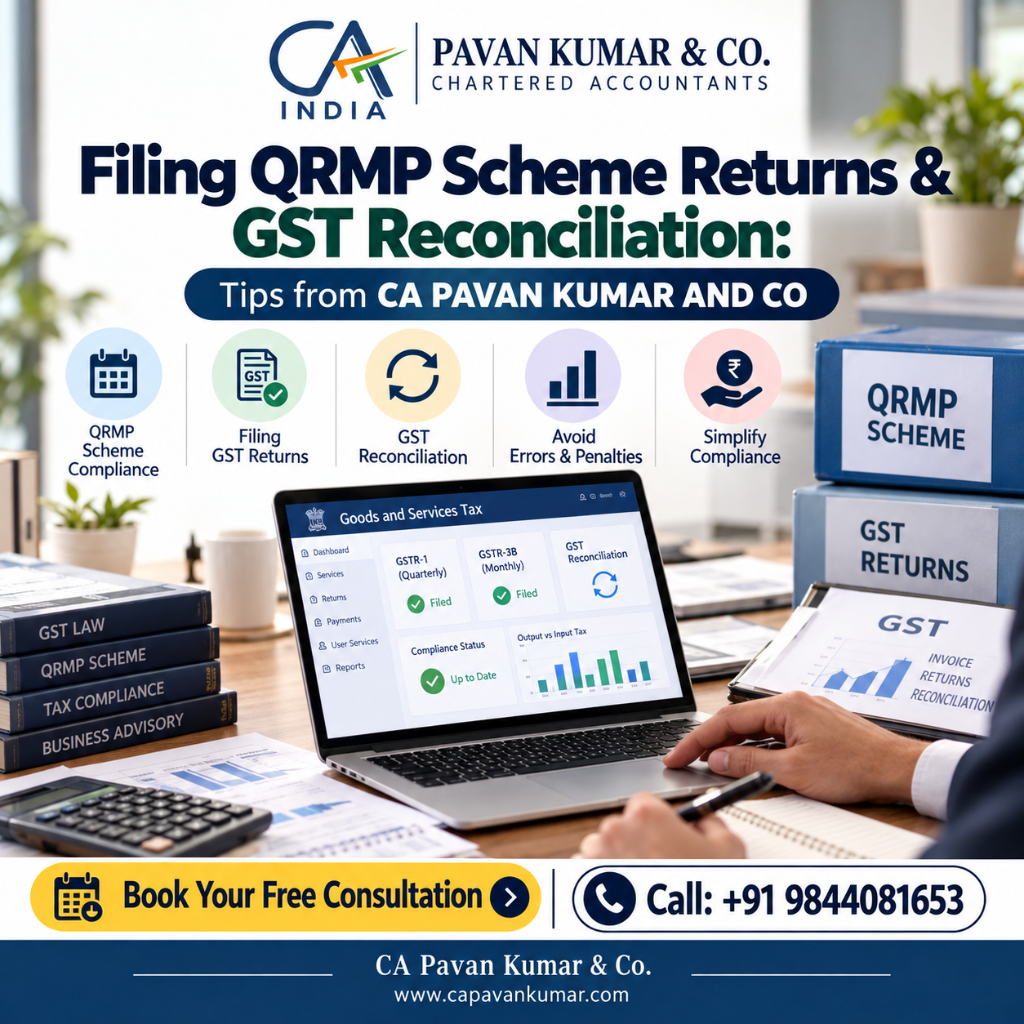
Introduction:
GST can be complex for small businesses as there are multiple documents (sales and purchase invoices, GST returns, tax payments) which need to be managed simultaneously.
To ease return filing for small taxpayers, the GST QRMP scheme allows eligible taxpayers to do quarterly return filing and pay tax. As per the guidance available on the GST portal, taxpayers with an annual turnover less than or equal to INR 5 Crore may be eligible to adopt the Quarterly Returns with Monthly Payment (QRMP) scheme.
GST, Made Simple
Eligibility for the GST QRMP scheme does not mean that small taxpayers need not file returns during the other quarters. Regular GST records need to be generated and documentation (invoices, bills, etc.) need to be maintained.
Small and medium businesses and startups in Bangalore should outsource GST record-keeping and returns filing to ensure compliance without any hassles and avoid errors.
What is the GST QRMP scheme?
As per the scheme, small taxpayers can do quarterly returns filing and tax payment.
IFF allows taxpayers to delay providing certain reverse-charge supply details to the government for a period of 2 months.
GST Tutorials
Deferring GST work until the end of the quarter is not the only benefit of QRMP. Constant maintenance of purchase and sales records is crucial.
Businesses should assess their eligibility to avail the scheme, and comply with the conditions as mandated under the Scheme from time to time. Businesses should assess their eligibility and compliance requirements before availing/continuing QRMP.
Reconciliation of GST Under QRMP
Reconciliation of GST means identifying differences between financial records and GST records.
For e.g. A business can reconcile GST by comparing:
- Sales/Purchases as reflected in Sales/Purchases register with particulars furnished in respective GSTR-1/GSTR-2
- Books of Accounts with Outstanding liabilities
- Electronic Payment Records with Cash/Credit Ledger
- Credit/Debit Notes with Journal entries
There are various advantages of QRMP, one being that numerous transactions can be recorded during the quarter and need not be recorded on a real time basis. However, at the end of the quarter, a large volume of transactions can take a long time to review and correct. Timely conducting GST reconciliation will help identify discrepancies, omissions and requirements of additional invoices. This will also help ascertain input tax credit.
Under QRMP, understanding the differences between GSTR-1 and GSTR-3B will help taxpayers in addressing discrepancies between supplies reported and returns filed.
Under the QRMP, taxpayers who are eligible file their GSTR-1 quarterly. The facility of filing quarterly returns for outward supplies (IFF) is an option available for the first two months of a given quarter. The GST portal has mentioned that the facility IFF is to assist the recipient to receive the invoice details and such documents would be reflected in the recipient’s GSTR-2A.
GST Portal has mentioned certain Tutorials, and GSTR-3B is explained as ‘Summary’ Return, and to be filed by taxpayers to report the tax liability along with Input Tax credit and to clear the same.
It is advised that the figures reported on the GST returns be reconciled against the accounts data, outward supply details and other GST records.
Filing GSTR-3B returns is comparatively simple for a business and therefore, reviewing the return and accounting data of the business may also be useful for the business.
Who Can Benefit From QRMP Compliance?
QRMP compliances primarily benefits small and medium businesses. Availing professional services for QRMP compliances benefits the businesses in areas such as invoice and GST return preparation. This is applicable for:
- Start ups
- Small and growing businesses
- E-commerce and service businesses
- Businesses with multiple GST registrations
- Other businesses with complex nature of operations
Business Owners Across India
It’s possible that some of your colleagues in other states will also need to comply with QRMP. Depending on your state, GSTIN, type of transactions and other factors, the process may vary.
Key Documents and Records Required
Following documents and records must be retained by the business to prepare GST returns and perform reconciliations:
- Invoices issued and received by the business
- Sales and purchase registers
- Credit and debits notes
- GST registration details
- Records pertaining to GSTR-1, GSTR-3B and GSTR-2B
- Electronic cash and credit ledger
- E-way bills
- Bank statements
- Books of accounts
- GST returns
- Other records pertaining to the input tax credit claimed by the business
- E-invoices
The documents to be retained vary based on the type of transactions undertaken by the business and the applicable provisions of GST.
GST QRMP Compliance
1. Qualify for QRMP
The first step is to see if the business is eligible to avail the benefit of QRMP. The GST portal has notified that the eligibility condition of the business includes aggregate annual turnover of the business is less than Rupees Fifty Lakh and the business has filed the GSTR-3B for the pertinent period.
GST Tutorials
2. Maintain Records of Sales
Although the business is authorized to furnish GST returns on a quarterly basis, sales records must be maintained continuously.
3. Examine Purchase Records and ITC
Purchase records must be examined to determine the reason for difference, if any, with GSTR-2B before the input tax credit is claimed.
GST Tutorials
4. Compute Tax Liability
The QRMP eligible businesses must calculate the tax liability for the first two months and pay the tax through the mode prescribed by the GST department.
The rules prescribe the amount and the manner of furnishing the information. The taxpayer has to determine the same having regard to the applicable GST rules.
5. IFF where Appropriate
Use of IFF is voluntary. This may be adopted in cases where bringing invoices earlier is of commercial/ operational use.
6. Reconciliation prior to Quarterly Return
The accounting records, outward supplies and ITC/ tax credit and/ or payment records must be reconciled prior to filing quarterly returns.
7. Return Filing
The reviewed information is to be used for completing the quarterly returns and submitting the same on the portal within the time permitted.
The GST portal facilitates taxpayers to preview return information prior to filing returns. Therefore, taxpayers are advised to conduct the final review of information prior to filing returns.
The GST Portal provides a number of useful features. Various tools and information presented on the GST portal assist taxpayers to undertake requisite analysis and/ or assess the impact of various provisions of the GST law and rules before filing the returns.
Common Errors to Avoid
While preparing the returns, taxpayers should be mindful of the following common errors.
- Considering quarterly return filing as quarterly book keeping.
- Not verifying quarterly eligibility.
- Not reconciling books of account.
- Not reporting sales in books and GSTR-1 in conformity.
- Not reviewing GSTR-2B while availing input tax credit.
- Failing to consider credit/ debit notes.
- Incorrect input of GST Identification Number (GSTIN).
- Failure to make tax payments within specified time.
- Not reconciling GSTR-1 and GSTR-3B.
- Not considering amendments effected in previous returns.
- Delaying GST returns reconciliation.
- Not reviewing the final return summary prior to filing returns.
Benefits of Professional GST Services
Pecuniary and non-pecuniary benefits are expected from professional GST services. Some of the advantages are improved reconciliation and organization of return filing and other GST related activities.
Better ITC Review
A business can match its purchase records against its GST records. Only after comparing the two records can a business claim any input tax credit (ITC).
Less Administrative Workload
By outsourcing the maintenance of books of account and compliance to a professional firm, business owners can devote more time to the core business activities.
Outsourcing Accounting and GST Services
GST compliance requires a business to review its books of account and documents. So, GST compliance and other accounting activities are integrated.
A tax consultant can help a business understand these integrities.
Why Us?
Pavan Kumar & Co. is a Bengaluru-based Chartered Accountant firm, started in 1985.
The firm offers a range of services in the field of Chartered Accountancy including GST compliance and returns, accounting and bookkeeping, income-tax returns, audit and assurance, business and professional services, payroll and TDS, GST and income-tax litigation, NRI tax consultancy and advisory services.
NRI clients especially find their range of services appealing because of the integration of GST and income-tax consultancy.
Pavan Kumar & Co. assists clients with GST compliance including the GST QRMP scheme. The firm has offices in Seshadripuram and Bommanahalli, Bangalore.
Frequently Asked Questions
1. What is GST QRMP scheme compliance?
GST QRMP scheme compliance refers to meeting the applicable requirements under the Quarterly Returns with Monthly Payment Scheme, including monthly tax payments for the relevant months and quarterly filing of GSTR-1 and GSTR-3B for eligible taxpayers. GGST Tutorials
2. Who is eligible for the QRMP Scheme?
GST Portal guidance states that taxpayers with aggregate turnover up to ₹5 crore, subject to applicable conditions, can be eligible for QRMP. The taxpayer must also satisfy the relevant return-filing conditions. Eligibility should be verified against current rules. GGST Tutorials+1
3. Is IFF mandatory under QRMP?
Reduced Administrative Pressure
No. The Invoice Furnishing Facility is an optional facility for eligible QRMP taxpayers for furnishing certain outward-supply details during the first two months of a quarter. GGST Tutorials
4. Why is GST reconciliation important?
GST reconciliation helps identify differences between accounting records, sales and purchase registers, GSTR-1, GSTR-3B, GSTR-2B and other relevant data. Regular reconciliation can help businesses detect errors before they become more difficult to resolve.
5. Can a CA help with GSTR-3B filing?
Yes. A CA can assist with reviewing accounting records, GST data, eligible input tax credit and tax liabilities and can provide GSTR 3B filing support based on the business’s specific requirements.
Make GST Compliance More Manageable
The QRMP Scheme can simplify the filing frequency taxation, audit and financial advisory services to provide integrated support for individuals and businesses. Whether you are a startup, small business, growing enterprise or NRI with Indian tax and GST requirements, the appropriate compliance process for eligible small taxpayers, but it does not remove the need for disciplined GST accounting.
Businesses should continue recording invoices, monitoring tax liabilities, reviewing input tax credit, reconciling GST data and tracking applicable payment and filing requirements throughout the quarter.
For businesses in Bangalore, Seshadripuram and across India, professional support can make this process more systematic and easier to manage.
Pavan Kumar & Co. combines accounting, GST, taxation, audit and financial advisory services to provide integrated support for individuals and businesses. Whether you are a startup, small business, growing enterprise or NRI with Indian tax and GST requirements, the appropriate compliance process should be based on your specific circumstances and current regulations.
Get an appointment to speak with our expert team and discuss your accounting and compliance requirements.
Pavan Kumar & Co.
Sannidhi, 26, RK Street, Jai Bheema Nagar, Seshadripuram, Bengaluru, Karnataka – 560020
Call: +91 9844081653
Email: capavankumars@gmail.com
This blog is for educational purposes only and should not be treated as tax, legal, or financial advice. Please consult a qualified chartered accountant for advice based on your specific situation.