
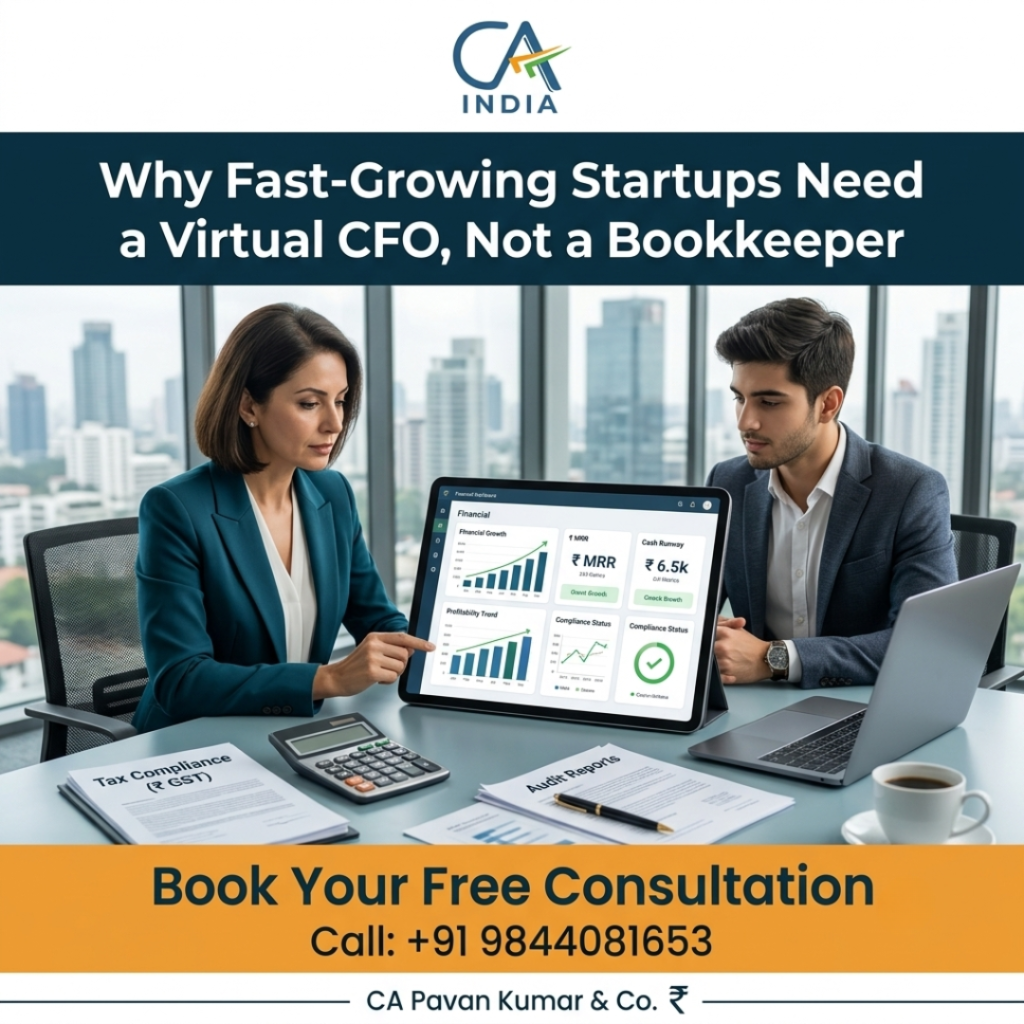
A good bookkeeper is a crucial asset during a startup’s infancy. They keep receipts, reconcile bank accounts, and complete tax filings. Essentially, they record your startup’s history.
However, during your growth phase—such as when you hire your 20th employee, manage multiple GST registrations, or prepare for Series A fundraising—you will realize that a bookkeeper cannot answer strategic questions. They cannot explain why your margins are declining, nor can they tell you how to adjust your cash runway to survive economic volatility.
This is the “Financial Gap.” Most startups mistakenly believe they have an accounting gap when, in reality, they have a financial strategy gap. At CA Pavan Kumar & Co., we specialize in closing this gap. Here is why your fast-growing startup should transition from bookkeeping to a Virtual CFO (vCFO) model.
1. Scorekeepers vs. Coaches
The most notable difference is their focus.
- The Scorekeepers: Bookkeepers and accountants record the past. They prepare history books (Balance Sheets and P&Ls) through compliance reviews.
- The Coaches: A Virtual CFO looks past the accounting function. They derive recorded data to develop business strategy. While your accountant tells you what happened last month, your vCFO guides you on strategies to win the next quarter.
2. When to Upgrade?
There is no magical revenue figure that dictates the need for a vCFO, but specific “pain points” indicate you have outgrown a bookkeeping-only model:
- The Numbers Gap: You cannot state your monthly burn and runway without waiting days for your accountant to “run the numbers.”
- Fundraising Challenges: You are planning a funding round, but your financials are not in an investor-ready format.
- Compliance Challenges: You struggle with multiple GST registrations, foreign remittances (FEMA), and complicated payroll taxes, and your current team is overwhelmed or missing deadlines.
- Strategic Challenges: You are launching a new product or hiring senior leadership, but you have no visibility into your cash runway for the next 12 months.
3. What a vCFO Does for Your Startup
A vCFO does not replace your accountant; they manage your financial infrastructure and empower your existing team.
- Financial Modeling & Forecasting: They construct rolling cash flow forecasts rather than just providing rearview-mirror reporting.
- Investor Relations: They translate complex internal data into “investor-ready” MIS (Management Information Systems) dashboards that VCs demand.
- Margin & Unit Economics: They break down your pricing, Customer Acquisition Cost (CAC), and Lifetime Value (LTV) to ensure your growth is sustainable and profitable.
- Risk Mitigation: They detect financial “leakage” from inefficient vendor payments or tax-inefficient structures that a bookkeeper may lack the authority to address.
4. Why the Virtual Model Wins
Hiring an in-house CFO with 15 years of experience often proves too costly for an early-stage company.
- Cost-Effectiveness: You gain senior-level financial “brainpower” at a fraction of the cost, typically via a monthly retainer.
- Scalability: You can increase engagement during funding rounds or year-end audits and scale back during stable periods.
- Institutional-Grade Experience: A vCFO from a CA firm brings experience across many firms and industries, providing a broader perspective than a single in-house employee.
Stop Growing Blind
Your startup is growing, but your financial infrastructure may be stagnant. Don’t let poor financial foresight cause your vision to fail. Our Virtual CFO team acts as your strategic finance partner—managing your bookkeeping, optimizing your cash flow, and preparing you for your next major milestone.
Book your appointment today:
- Website: https://capavankumar.com/
- 📞 Call us: +91 9844081653
- 📧 Email: capavankumars@gmail.com