
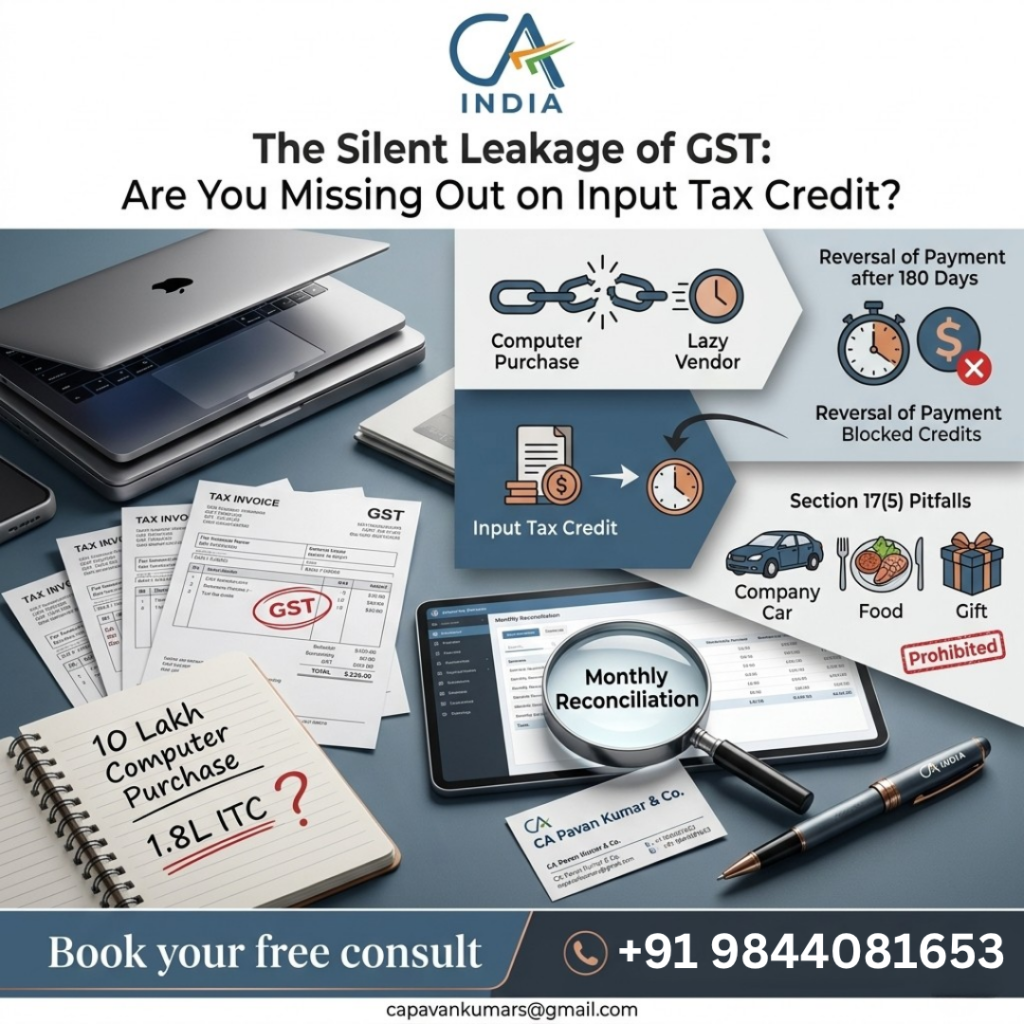
You recently purchased new computers worth ₹10 Lakhs for your expanding engineering team.
The merchant has charged you 18% GST, making the total invoice ₹11.8 Lakhs. You paid it without blinking an eye. You know how GST works, after all. That ₹1.8 Lakhs you paid in tax is not an expense. That is an Input Tax Credit (ITC). When you file your own GST return, you will utilize that credit to offset your tax burden. It’s almost as good as cash.
But your accountant comes back a month later with terrible news:
“We can’t claim the ₹1.8 Lakhs ITC. You have to pay the entire tax liability from your own pocket.”
Suddenly, your business is down ₹1.8 Lakhs in cash flow. What occurred?
At CA Pavan Kumar & Co., we see this same scenario play out all the time. Business owners believe that they can claim ITC if they have a tax invoice. But under today’s GST legislation, your eligibility to claim your own money depends solely on the behavior of your merchants.
Here’s why your firm can be losing thousands of rupees in unclaimed GST, and how to plug the holes.
1. The GSTR-2B Trap (The Lazy Vendor Problem)
Under the old tax regime, you had a physical invoice, and you claimed the credit. Today, the GST portal is fully automated and cross-referenced.
- The Rule: You can claim ITC only if your vendor actually files that particular invoice in their GSTR-1 report. Once they do, it mysteriously reflects in your auto-generated GSTR-2B statement.
- The Problem: If your vendor is lazy, files their returns late, or enters the wrong GST number on the portal by mistake, that invoice will not appear in your GSTR-2B.
- The Result: You won’t be able to claim the credit due to the government’s system. You pay the tax to the vendor, but the government hasn’t received it. So you lose out.
2. Reversal of Payment after 180 Days
This is a silent trap that many firms fall into during audits. Sometimes, to control cash flow, you might arrange a long payment cycle with a supplier, or you might withhold payment due to a dispute over the quality of the items.
- The Rule: As per GST rules, if you do not pay your vendor the full invoice value (including tax) within 180 days from the date of the invoice, you will have to reverse the ITC if you have already claimed it on it.
- The Consequence: Not only do you have to return the tax credit to the government, but you will also be taxed at a high 18% interest on the days you had that credit!
3. The “Blocked” Credits (Section 17(5))
Many founders believe they can take ITC on every business expense that has GST. This is an expensive misconception.
Section 17(5) of the GST Act lists a range of costs for which ITC is rigorously banned, even if for a valid business purpose.
- Typical Examples: Company car for directors (unless you are running a taxi/driving school business), food and beverages for the workplace, gym memberships for employees, or gifts for clients.
If your accountant naively claims ITC on these restricted items, the GST department will eventually issue a letter seeking the money returned, along with severe penalties.
4. Discrepancy in E-Way Bill
If your firm involves the movement of physical commodities worth more than ₹50,000, then you must generate an E-Way Bill.
During the GST audit, officers will closely examine the relationship between the E-Way Bills you have created and your GSTR-1 (sales) and GSTR-3B (tax payment) forms. If you have generated an E-Way Bill to transfer items, but omitted to include that invoice in your monthly sales report, the tax authorities would see it as intentional tax avoidance.
Solution: Vendor Reconciliation per Month
Looking at your books once a year will not cure these GST leaks. The approach necessitates strong, monthly discipline.
Your finance staff has to do a Reconciliation before filing your GSTR-3B on the 20th of the month. They have to match each purchase invoice in your software with the GSTR-2B data on the government’s portal.
If an invoice isn’t available, your staff needs to call the vendor right away and ask them to upload it, or you won’t pay them until they do.
Stop Paying Tax for Your Vendor’s Mistakes
GST compliance is no longer just about form filing. It is a key cash flow management instrument. Don’t let sloppy vendors or internal accounting errors steal from you the tax credits you paid for and are rightly owed.
Let our experienced GST staff take care of your monthly reconciliations, so you never lose a rupee of your Input Tax Credit.
Book your appointment today by visiting our website: https://capavankumar.com/
- 📞 Call us: +91 9844081653
- 📧 Email: capavankumars@gmail.com