
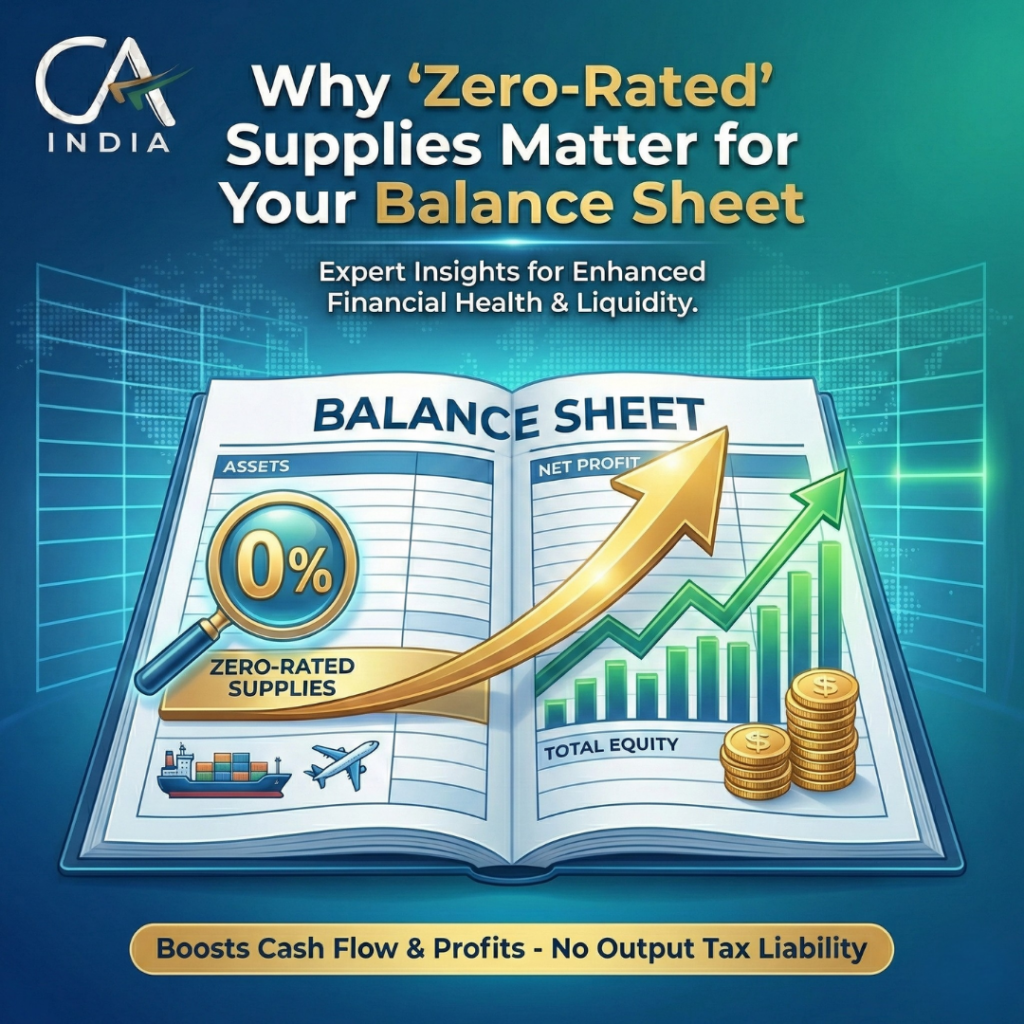
In the world of GST, three terms sound the same but mean completely different things:
- Nil-Rated
- Exempt
- Zero-Rated
To a layman, they all mean the same thing: “I don’t charge any tax to my customer.” But to a Chartered Accountant (and your Balance Sheet), the difference between them is the difference between Profit and Loss.
At CA Pavan Kumar & Co., we often see businesses misclassifying their products. If you mark a “Zero-Rated” supply as “Exempt” in your software, you might be throwing away lakhs of rupees in refunds.
Here is why “Zero-Rated” is the VIP category of GST.
1. The Definition: What is Zero-Rated?
In the GST law, “Zero-Rated Supply” refers to only two specific things:
Exports: Selling goods or services outside India.
SEZ Supplies: Selling goods or services to a Special Economic Zone (SEZ) unit or developer.
That’s it. Nothing else is Zero-Rated. Grain, milk, and salt are Exempt or Nil-Rated. They are NOT Zero-Rated.
2. The Golden Difference: Input Tax Credit (ITC)
Here is the math that matters.
Scenario A: You sell “Exempt” Goods (e.g., Bread)
You buy raw materials (flour, yeast, and packaging) and pay a GST of ₹10,000 on them.
You sell the Bread. No tax is collected.
The Result: The government says, “Since you didn’t collect tax, you can’t claim credit.”
The Loss: That ₹10,000 tax you paid becomes a cost. It eats into your profit. You cannot get it back.
Scenario B: You make a “Zero-Rated” Supply (e.g., Exporting Shirts)
You buy fabric and buttons and pay ₹10,000 GST on them.
You export the shirts. No tax is collected.
The Result: The government says, “We want to encourage exports. So, even though you didn’t collect tax, we will refund you the ₹10,000 you paid on inputs.”
The Profit: That ₹10,000 comes back to your bank account. It is NOT a cost.
3. The “Letter of Undertaking” (LUT) Connection
To enjoy the benefits of Zero-Rated supplies without blocking your working capital, you need to file a Letter of Undertaking (LUT) at the start of the year. This allows you to sell without charging tax and still claim the refund on your purchases. If you forget to file the LUT, the department might demand that you pay tax on those exports first and claim a refund later—a cash flow nightmare.
4. Be Careful with “SEZ” Proof
Selling to an SEZ (like a tech park in Whitefield) is treated the same as an export. But there is a catch: You must prove the goods were actually “admitted” into the SEZ. You need an endorsement from the Specified Officer (SO) of the SEZ on your invoice. Without this signature/stamp, your Zero-Rated status can be denied, and you will be asked to pay 18% tax.
5. Don’t Mix Them Up in GSTR-1
When filing your GSTR-1 return, there are separate columns for “Exports” (Table 6A) and “Nil Rated/Exempt” (Table 8). If you enter your export sales in the “Exempt” column by mistake, the automated system will block your refund. Correcting this later is a long, painful process.
Classify Correctly, Profit Instantly
GST is not just about paying what you owe; it’s about claiming what is yours. “Zero-Rated” is a privilege given to exporters to make them competitive globally. Make sure you are using it.
Are you an Exporter or SEZ Vendor? Contact CA Pavan Kumar & Co. We ensure your documentation is perfect so your refunds flow smoothly.
Schedule your appointment now by visiting our website https://capavankumar.com/
📞 Call us: +91 9844081653
📧 Email: capavankumars@gmail.com