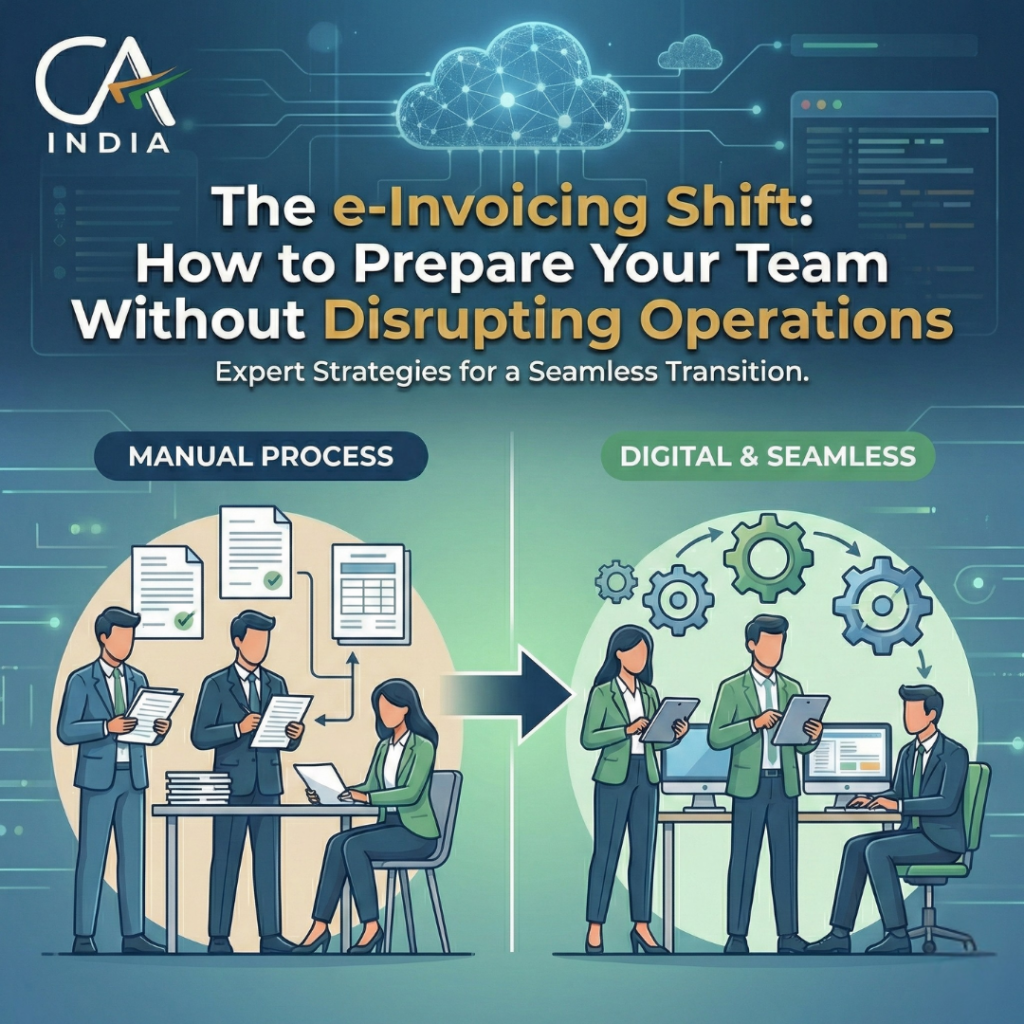
For decades, an “invoice” was just a piece of paper you printed, signed, and couriered.
Then, it became a PDF you emailed.
Now, it is a piece of code validated in real time by the government.
Welcome to the era of e-Invoicing.
If your business turnover exceeds the government threshold (which has steadily dropped from ₹500 Cr to ₹5 Cr), you cannot issue a standard bill anymore. If you do, it is legally invalid. Your customer cannot claim credit, and they likely won’t pay you.
At CA Pavan Kumar & Co., we have helped dozens of businesses transition to this system. The good news? Once set up, it’s actually faster than the old way. The bad news? If your team isn’t trained, it can halt your dispatch trucks at the gate.
Here is how to upgrade your billing process without the chaos.
1. What is e-Invoicing? (It’s Not Just a PDF)
Many people think e-Invoicing means “electronic invoice” (like a PDF). Wrong.
It means “authenticating” your invoice with the government before you issue it to the customer.
- The Process: You create a bill in your accounting software right arrow The data goes to the Government Portal (IRP) right arrow The Portal stamps it with a unique 64-character hash (IRN) and a QR Code right arrow It comes back to your software.
- The Rule: A B2B invoice without this specific QR Code is just a piece of waste paper.
2. Software is Your Best Friend
You cannot do this manually. You cannot go to a government website and type 500 invoices a day.
You need ERP integration.
Whether you use Tally, Zoho, SAP, or a custom tool, ensure it is “e-Invoice Ready.” The software should do the talking with the government portal in the background. Your accountant should just hit “Save,” and the QR code should appear automatically.
3. The “No Edit” Discipline
This is the biggest culture shock for staff.
In the old days, if you made a mistake (wrong truck number, wrong spelling), you would just tear up the bill and print a new one.
With e-Invoicing, you cannot edit.
Once an IRN is generated, it is locked. To fix a mistake, you must cancel the IRN within 24 hours and develop a fresh one. If you miss the 24-hour window, you have to issue a Credit Note.
- Actionable Tip: Train your data entry staff to triple-check details before generating the IRN.
4. Impact on Dispatch (The E-Way Bill Link)
The best part of e-Invoicing is that it auto-generates your E-Way Bill.
Part A of the E-Way bill is automatically filled using the e-Invoice data. This saves your logistics team significant time.
- Warning: Ensure the “Hsn Code” and “Pin Codes” are accurate. A mismatch here will prevent the E-Way bill from being generated, leaving your truck stranded.
5. Don’t Forget the Customers
Inform your B2B clients that you have shifted to e-Invoicing.
They need to check your bills for the QR code. If they don’t see it, they might reject the bill because their own audit teams won’t accept it for Input Tax Credit purposes.
Future-Proofing Your Business
The government’s ultimate goal is for every B2B transaction to be e-Invoiced. Even if you are below the threshold today, it is wise to adopt the system voluntarily. It makes your business look tech-savvy and transparent.
Need help integrating e-Invoicing with your current software?
Contact CA Pavan Kumar & Co. We guide your IT and Accounts teams to ensure a zero-downtime transition.
Schedule your appointment now by visiting our website : https://capavankumar.com/
📞 Call us: +91 9844081653
📧 Email: capavankumars@gmail.com