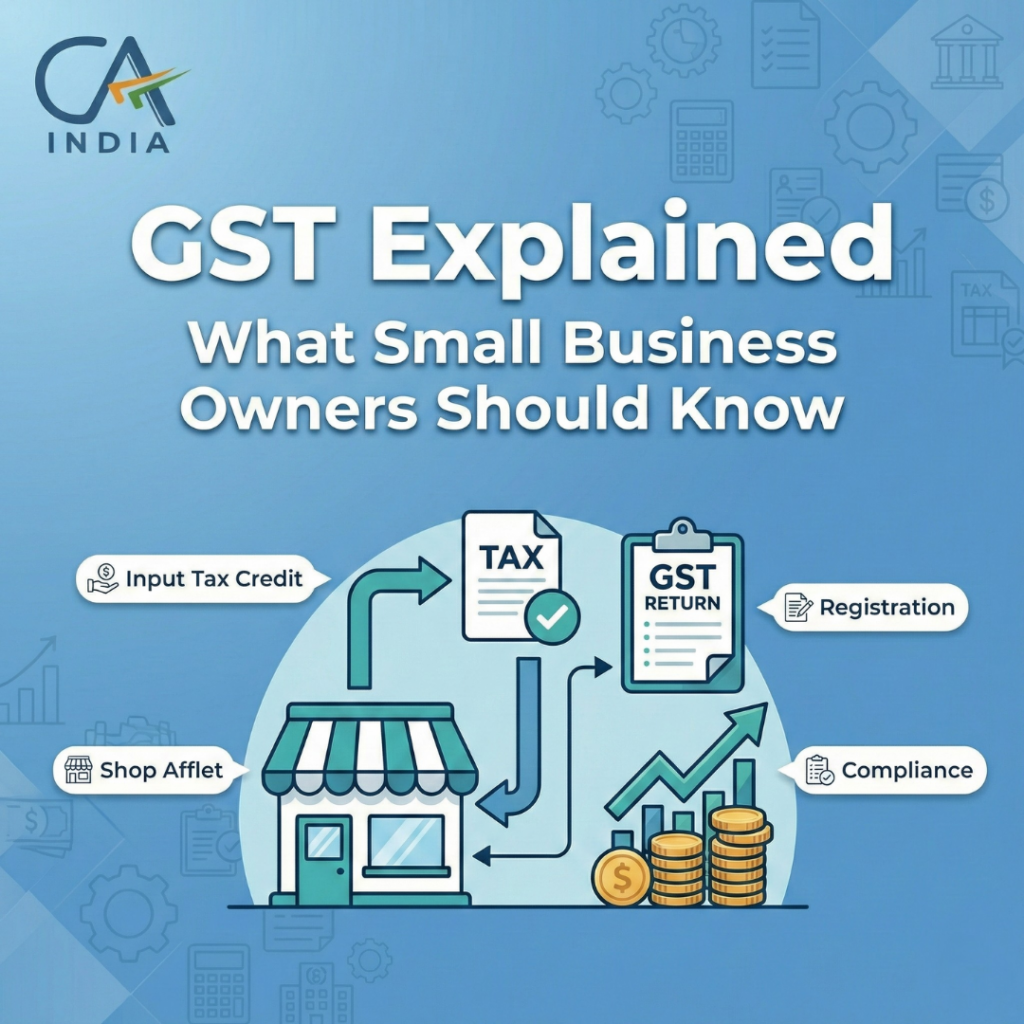
Every business owner knows what GST stands for, but very few can accurately explain what GST is.
Since the introduction of the Goods and Services Tax in 2017, the business world has changed once again. For small and medium owners across the country, the GST still feels like a jumble of compliance, rates, and portals.
Do I really need to register? What is the difference between SGST and IGST? Why is my supplier asking for my GST number?
At CA Pavan Kumar & Co., we believe compliance should empower your business, not stifle it. What does GST really mean for your business?
- The “20 Lakh vs. 40 Lakh” Rule: Do I Need to Register?
Am I required to register? The answer to that really depends on what you’re selling.
Service Providers: If you provide services as a consultant, architect, or even a salon, you MUST register if your annual turnover exceeds 20 Lakhs.
Vendors of Goods: When selling merchandise such as clothing, electronics, or groceries, the limit is usually higher at ₹40 Lakhs (for most states).
The “Voluntary” Aspect: Registration is possible before reaching the threshold. Why would someone do this? It’s mostly done to enhance legitimacy when dealing with larger businesses, or to offset taxes through an “Input Tax Credit” (more on this in the next section).
- The “Cashback” With GST You May Not Have Known About (Input Tax Credit)
This is undoubtedly the most significant benefit of GST, yet the majority fail to realize it. It can best be described as a system that allows you to get ‘cashback,’ or, in this case, an Input Tax Credit (ITC).
Example: Let’s say you purchase some raw materials for ₹100. You would be charged an additional ₹18 in taxes. You then sell the completed product to a customer for ₹150, and you would collect an additional ₹27 in taxes.
The “Magic”: Instead of being obliged to pay the government the full ₹27, as a GST-registered seller, you would be paying the government only the net amount, which is the difference between the taxes collected ($27) and the taxes paid ($18). Hence, you would only pay them ₹9.
The “Catch”: You can lose this “cashback” opportunity if your supplier fails to remit your funds to the government promptly. This is why vendor management becomes critical.
- The Acronyms: CGST, SGST, IGST
They look confusing on the invoice. The logic behind all of them is elementary, and it hinges on your customer’s location.
Selling Within the Same State (e.g., Bangalore to Mysore): You cross the Tax. Half goes to the Center (CGST), and half goes to the State (SGST).
Selling Outside the State (e.g., Bangalore to Mumbai): You charge a single Tax called IGST (Integrated GST).
Simple Rule: Local sale = Split Tax. Interstate sale = Single tax.
- The “Easy Mode” for Small Players: Composition Scheme
If the fear of filing monthly returns haunts you, the government provides an “Easy Mode” called the Composition Scheme.
Who is it for? Businesses with turnover up to ₹1.5 Crores.
The Benefit: You pay a flat, low rate of Tax (typically 1% for traders/manufacturers) on your turnover. Return filing is only once a quarter.
The Trade-off: You can’t collect Tax from your customers, and you can’t claim Input Tax Credit. It’s a trade-off: simplicity versus losing tax benefits.
- Compliance is Not Optional
In the good old days, you could get away with filing returns only once a year. With GST, it’s a different ball game.
Discipline is the name of the game.
GSTR-1: What you sold (filed monthly/quarterly).
GSTR-3B: Tax payment (filed monthly).
Missed deadlines incur a late fee of ₹50 per day. It might seem minor, but it adds up really fast, and worse, it blocks your e-way bills.
Stop Worrying, Start Growing
GST is an obstacle. After your systems are set up, they are built to run on autopilot. If manual bills are still being written or invoices are being mismatched with the portal, there is excessive work being done.
Need a GST Health Check for your business? Contact CA Pavan Kumar & Co. We handle the filings so you can focus on sales.
Schedule your appointment now by visiting our website: https://capavankumar.com/
📞 Call us: +91 9844081653
📧 Email: capavankumars@gmail.com